.webp)
When companies post a job opening, they’re not just writing a description — they’re making a decision about who will even see it. And that decision, remote vs. onsite, has a measurable impact on every step of the recruitment pipeline.
We recently analyzed pipeline performance across two live client engagements recruiting software developers in Latin America. The numbers confirmed what many hiring teams already sense but rarely quantify.
Remote vs. Onsite Hiring: Two Pipelines, One Clear Pattern
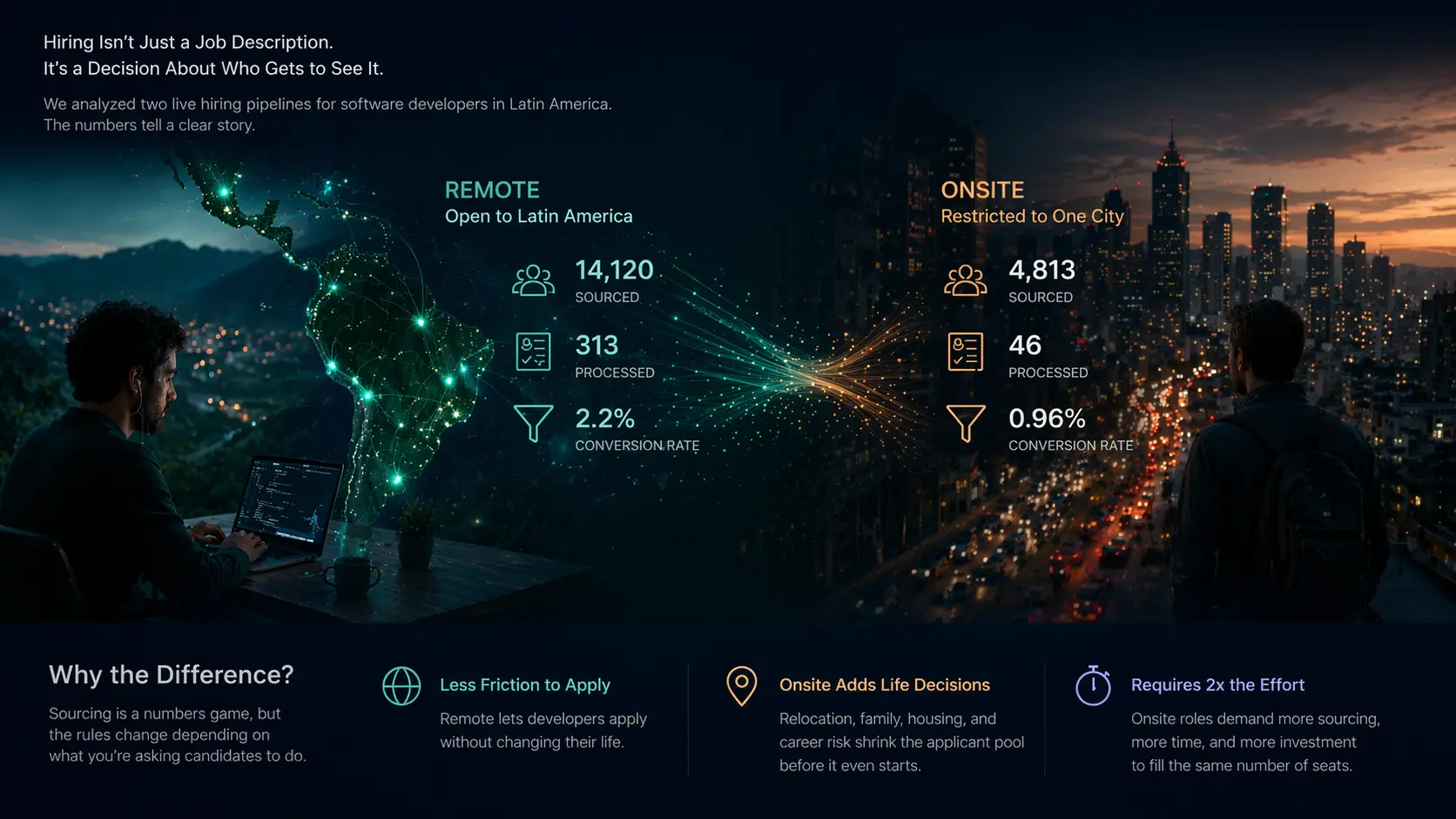
Company A hired for Full-Stack and Frontend roles on a fully remote basis across Latin America. We sourced 14,120 prospects across 15 countries, processed 313 candidates, and reached a 2.2% conversion rate from sourced to processed — comfortably within the market benchmark of 2–5% for remote positions.
Company B hired for seven technical roles — iOS, Android, QA, and Data — in a 100% onsite format, restricted to a single city. We sourced 4,813 prospects, processed 46 candidates, and landed at a 0.96% conversion rate — also within benchmark, but within a benchmark that is nearly half as efficient: 0.5–1.5% for onsite positions.
The key takeaway: onsite roles require approximately 2x the sourcing effort per qualified candidate compared to equivalent remote roles.
That’s not a flaw in the process. It’s structural. It’s what happens when geography becomes a hiring prerequisite.
Why Remote and Onsite Conversion Rates Differ
Sourcing is a numbers game, but the rules change depending on what you’re asking candidates to do.
When a role is remote, a qualified developer in Bogotá, São Paulo, Mexico City, or Lima can apply without changing their life. When a role is onsite in a specific city, that same developer has to weigh relocation, family ties, housing costs, and career risk before even submitting a resume. Most won’t.
Full-cycle recruiting for onsite roles requires your sourcing team to work harder, reach further, and invest more time to fill the same number of seats — this structural drag compounds across every open role.
The Size of the LATAM Developer Talent Pool — and What Onsite Leaves Behind
To understand why the remote/onsite gap matters so much in Latin America, it helps to look at the scale of the regional talent market. Latin America’s technical workforce is considerably larger than most hiring managers outside the region realize.
According to GitHub’s Octoverse data, Brazil alone has more than 3 million developers, with Argentina adding close to 700,000 and Colombia another 660,000. Mexico, Peru, Chile, and the rest of the region bring the total to an estimated 7–8 million active software developers across Latin America — a pool growing at double-digit rates year over year.
That number can create a false sense of abundance for companies hiring onsite.
The reality is that a large proportion of those developers are concentrated in a handful of urban centers. In Mexico, most of the country’s tech industry is anchored in Mexico City. In Colombia, Bogotá and Medellín together account for the vast majority of the country’s technology workforce — Colombia hosts roughly 13% of Latin America’s digital-solution providers, concentrated almost entirely in those two cities. In Peru, Lima accounts for roughly 80% of the country’s tech economy. In Argentina, the Buenos Aires metropolitan area dominates similarly.
So when a company posts an onsite role in any of these cities, they’re not accessing the regional pool — they’re competing in a local sub-pool, against every other company in that city, for the same candidates that remote-first employers are also pursuing.
.webp)
The Commute Factor: Why Even Large Cities Can’t Hold Their Developers
Here’s a detail that often gets overlooked when companies plan for onsite hiring in major LATAM cities: even a developer who lives in the same city as your office may not be willing to make that commute.
Traffic in Latin America’s largest cities ranks among the most congested in the world. According to the TomTom Traffic Index 2025:
- Lima leads the group — drivers lose an average of 195 hours per year (more than 8 full days) to rush-hour traffic. A 10-kilometer commute takes over 43 minutes in the morning and more than 51 minutes in the evening.
- Mexico City — 184 hours lost per year to congestion. An evening rush-hour commute of 10 kilometers takes nearly 48 minutes at an average speed of 12.7 km/h.
- Bogotá and Medellín both register 153 hours lost per year in traffic, with Medellín’s evening rush-hour congestion increasing year over year.
- Buenos Aires — 126 hours per year, with rush-hour commutes averaging 36–39 minutes for a 10-kilometer trip.
To put those numbers in context: a developer commuting to an onsite role in Lima is losing the equivalent of nearly a full month of working hours every year just sitting in traffic. Mexico City’s developers are not far behind.
This matters because these same developers have increasing access to remote roles with internationally competitive salaries that eliminate that cost entirely. When the choice is a 90-minute daily commute to earn a local salary versus working from home for a US-based team at a 20–40% premium, the calculus becomes straightforward.
What Broader Research on Remote Hiring Confirms
This dynamic doesn’t only appear in our pipeline data. It shows up consistently in industry-wide research.
Candidate preferences have shifted permanently. According to Buffer’s 2023 State of Remote Work report, 98% of remote workers say they want to continue working remotely at least some of the time for the rest of their careers. 71% now prefer fully remote arrangements — up from 49% just one year prior. These aren’t temporary attitudes; they reflect a structural change in how developers evaluate opportunity.
Gallup’s data reinforces this. Among remote-capable employees, only 6% prefer to work fully onsite. 34% prefer fully remote, and 60% want some form of hybrid. The pool of candidates genuinely eager for full-time in-office work is a minority — and in competitive technical markets, that matters significantly at the top of the funnel.
Geographic restrictions shrink already-tight talent pools further. LinkedIn’s Global Talent Trends data consistently shows that remote job postings attract significantly more applications than equivalent onsite listings — often by a factor of 2 to 3. In specialized roles like mobile development, data engineering, or QA automation, this gap becomes more pronounced.
Stanford economist Nicholas Bloom’s research on remote work productivity found that remote workers are approximately 13% more productive than their onsite counterparts, due to fewer interruptions, no commute fatigue, and greater autonomy. His ongoing research through WFH Research confirms that hybrid and remote arrangements have sustained productivity parity — or better — versus full in-office work.
And once a developer is hired, the retention story follows the same pattern. Buffer found that 65% of remote workers manage stress more effectively when working remotely, and 70% find deep, focused work easier outside a traditional office. Gallup found that 60% of fully remote employees say they would be extremely likely to switch jobs if their remote flexibility were removed.
.webp)
When Onsite Is Non-Negotiable: Building the Pipeline Instead of Competing for It
Some companies cannot go remote. Hardware teams, regulated financial infrastructure, specific government contracts, or operational models that genuinely require physical presence — these are real, and the onsite requirement in those contexts isn’t negotiable.
But the companies that succeed with onsite hiring in Latin American cities have generally stopped treating the local talent market as a pool they can simply draw from whenever they have a vacancy. They’ve started treating it as something they have to actively build over time.
Mercado Libre runs an internal engineering training program in Argentina that develops junior and mid-level developers specifically for their technical stack and work culture. Rather than competing exclusively for experienced engineers — a scarce and expensive population in Buenos Aires — they invest in developing talent internally, building a pipeline that isn’t dependent on what the open market happens to have available.
IBM and Accenture both operate large development centers across Buenos Aires, Bogotá, São Paulo, and Mexico City, each with structured internal academies that recruit graduates, train them on specific technologies, and onboard them into client-facing teams. The model explicitly acknowledges that senior talent in these markets is constrained, and that the most sustainable path to building onsite capacity is growing it locally.
Laboratoria, a coding bootcamp operating in Lima, Santiago, São Paulo, Mexico City, and Bogotá, has trained thousands of women for technology careers — and counts among its corporate partners companies that were struggling to find entry-level tech talent through traditional channels. For an onsite employer in any of those cities, partnerships with programs like Laboratoria represent access to candidates who are locally committed, technically trained, and not currently being competed over by remote-first international companies.
Wizeline built much of its engineering capacity in Guadalajara rather than Mexico City — a deliberate choice to work in a market with strong university infrastructure (TEC de Monterrey, CUCEI) and lower competition for mid-level engineers than the capital. The model combines local university partnerships with an internal career development framework designed to retain people through growth opportunities rather than salary alone.
The common thread: onsite hiring at scale requires being in the talent development business, not just the talent acquisition business. Companies that wait until a vacancy opens and then post a job in a constrained local market will pay more, wait longer, and compromise more often than those who’ve been nurturing relationships, programs, and pipelines before the need becomes urgent.
.webp)
The Strategic Takeaway for Hiring Managers
For roles where remote work is viable, the pipeline advantages are clear. Hiring remote developers from across Latin America dramatically increases the top of the funnel, improves sourcing-to-processed conversion rates, and expands access to specialized skills that may not exist at sufficient density in any one location.
For roles where onsite is genuinely necessary, the calculus is different but the conclusion is similar: passive reliance on the open market isn’t sustainable. The commute burden in major LATAM capitals is real and growing. The competition for locally committed technical talent is intense — and increasingly includes remote-first employers who can match or exceed local compensation without requiring anyone to leave home.
Company B’s results were solid given the constraints they were operating under. But the 2x sourcing effort their onsite requirement demanded is a cost that doesn’t disappear. It gets paid in recruiter hours, agency fees, longer time-to-fill, or some combination of all three.
The data from Company A and Company B is a small but clear illustration of a broader market dynamic. Remote pipelines convert better because more qualified candidates are willing to engage. That’s the market working exactly as it should.
Frequently Asked Questions
What is the average conversion rate for remote developer roles in Latin America?
The market benchmark for remote developer roles in Latin America is 2–5% from sourced to processed candidate. In the pipeline data analyzed here, a remote LATAM engagement reached a 2.2% conversion rate — within benchmark and across 15 countries.
What is the average conversion rate for onsite developer roles in Latin America?
The market benchmark for onsite developer roles is 0.5–1.5% from sourced to processed. Onsite positions typically require approximately twice the sourcing volume per qualified candidate compared to equivalent remote roles, due to geographic restrictions reducing candidate willingness to engage.
Why do onsite roles in LATAM attract fewer applicants than remote roles?
Onsite roles in LATAM cities like Lima, Mexico City, Bogotá, and Buenos Aires limit the addressable talent pool to a single metropolitan area and require candidates to commit to a daily commute. Average commute times in these cities range from 126 to 195 hours lost per year (TomTom Traffic Index 2025). Combined with the growing availability of remote roles offering internationally competitive salaries, onsite requirements significantly reduce candidate conversion at the top of the funnel.
How large is the software developer talent pool in Latin America?
Based on GitHub Octoverse data, Latin America’s developer community includes approximately 3 million developers in Brazil, 700,000 in Argentina, 660,000 in Colombia, and a combined total estimated at 7–8 million across the full region. However, the majority of this talent is concentrated in a small number of major cities — making the effective “onsite-accessible” pool much smaller than the regional figure suggests.
What should companies do if they need to hire onsite developers in Latin America?
Companies with genuine onsite requirements should invest in talent pipeline development rather than relying solely on open-market recruiting. This includes university partnerships, internal developer academies, and bootcamp partnerships such as Laboratoria. For guidance on managing your team after hiring, see How to Manage Nearshore Development Teams.
What is the difference between nearshore and onsite hiring in Latin America?
Nearshore hiring refers to remote engagement of developers based in Latin America, typically as part of a US-based engineering team. Onsite hiring requires the developer to commute to or be based at a physical office in a specific LATAM city. Nearshore remote arrangements access the full regional talent pool; onsite arrangements are limited to a specific city’s commutable radius. Both have valid use cases, but the sourcing effort, conversion rates, and candidate willingness differ significantly.
Building a technical team in Latin America?
Whether you need remote engineers across the region or a dedicated team in a specific market, BetterWay Devs has built pipelines across 15 LATAM countries. Schedule a consultation →
BetterWay Devs is a nearshore IT recruiting and staffing company connecting software engineers across Latin America with technology companies in the United States. With over 16 years of experience building distributed engineering teams, we help companies navigate the balance between speed, quality, and long-term fit in technical hiring.
Paula Tellez
BetterWay Devs Inbound Marketing Manager
https://www.linkedin.com/in/paula-tellez/
Sources
Buffer, “State of Remote Work 2023” — buffer.com/state-of-remote-work
Gallup, “Returning to the Office: The Current and Future State of Remote Work,” 2022 — gallup.com
Bloom, Nicholas. WFH Research / Stanford Institute for Economic Policy Research — wfhresearch.com
GitHub, “Octoverse 2022: Global Tech Talent” — octoverse.github.com
TomTom Traffic Index 2025 — tomtom.com/traffic-index
LinkedIn, Global Talent Trends Report — business.linkedin.com/talent-solutions
Mordor Intelligence, Latin America IT Services Market — mordorintelligence.com


.png)
