.webp)
Introduction: The Strategic Case for Mexico
Mexico has transcended its former status as a backup resource to become the primary R&D partner for the Western Hemisphere. Under the "Plan Mexico" initiative, the nation is aggressively positioning itself as a top 10 global economy. This evolution is codified in the Executive Order enacted on January 21, 2025, which authorizes a staggering $30 billion MXN (approximately $1.5 billion USD) budget for tax incentives aimed at nearshoring and innovation.
Strategic leaders are no longer looking to hire developers in Mexico for simple cost arbitrage; they are integrating mexican software developer talent to build resilient, high-velocity engineering cultures. The core value proposition rests on a "Triple Helix" of geographic proximity to the united states, massive talent scale, and deep cultural alignment. This guide equips CTOs and HR leaders with the authoritative framework to:
- Capitalize on the scale and high-seniority distribution of the latin america talent pool.
- Navigate the regional specialization of hubs like Monterrey, Guadalajara, and the emerging AI corridor in Querétaro.
- Calculate the true Total Cost of Ownership (TCO), including the mandatory "hidden layer" of benefits.
- Mitigate risk through compliant hiring models and a sophisticated understanding of Federal Labor Law.
As we move toward 2026, the competitive advantage belongs to those who view Mexico not as a vendor, but as a long-term strategic pillar for global innovation.
Tech Talent Market Overview: Scale and Specialization
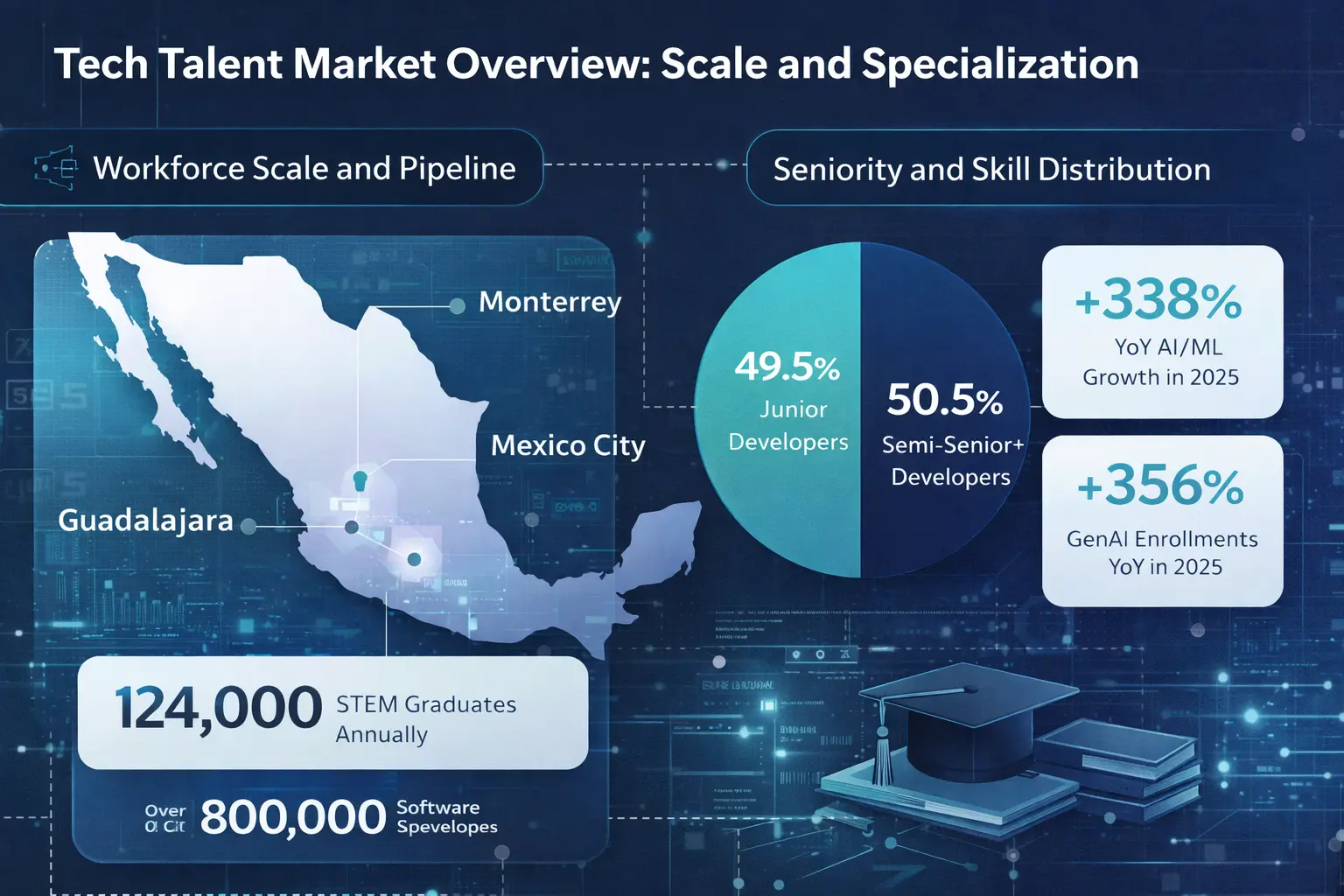
For north america leaders, understanding Mexico’s demographic depth is a prerequisite for effective resource planning. Unlike smaller nearshore markets, the mexican developer ecosystem provides the critical mass required for rapid enterprise scaling.
Workforce Scale and Pipeline
- Talent Pool Size: Mexico currently manages a robust ecosystem of over 800,000 software developers and ICT specialists.
- Graduation Rates: The pipeline is fed by more than 124,000 STEM graduates annually. This volume leads the Americas and ensures a sustainable flow of entry-level software engineer talent to support senior leadership. Unlike markets in eastern europe, which are facing demographic plateaus, Mexico’s youth bulge ensures a growing supply of skilled developer talent for the next decade.
Seniority and Skill Distribution
The Mexican market is characterized by high maturity and an aggressive pivot toward emerging technologies:
- Seniority Depth: Over 50% of the tech workforce is classified as semi-senior or higher, with 6+ years of experience being the standard for senior software engineering roles. This is particularly evident in the stack developer community, where engineers often transition from traditional web development to cloud-native architecture.
- Explosive Skill Growth: Reflecting the global AI race, AI/ML skills grew by 338% YoY in 2025. This is supported by GenAI enrollments, which surged by 356% as software developers upskill to meet international demand. There is also a notable concentration of elixir developer and ruby developer talent in niche startup circles.
- Language Proficiency: While english proficiency varies, high-proficiency hubs like Nuevo León and Jalisco produce remote engineers who typically demonstrate upper-intermediate (B2) to advanced English levels, ensuring seamless collaboration.
This scale guarantees that whether your roadmap requires standard enterprise development or niche systems engineering, the Mexican market possesses the requisite depth.
The Tech Ecosystem: Regional Hubs and Academic Foundations
The success of Mexico’s tech sector is anchored by the "Triple Helix" model—the strategic synergy between government policy, university research, and private industry.
Top Tech Hubs: Regional Specialization
Consultant Insight: Strategic leaders must watch Querétaro. With CloudHQ’s $4.8 billion investment and the state’s tech sector projected to grow 23% in 2026, the region is rapidly becoming Mexico’s strategic hub for AI and cloud workloads. This growth is attracting high-level nearshore software development firms and data center operators globally.
Academic Foundations
Mexico’s elite universities, including Tecnológico de Monterrey (ITESM), UNAM, IPN, and UdeG, are the engines of this growth. These institutions emphasize an international focus, featuring bilingual Spanish-English campuses that prepare latam developers for global standards. Furthermore, as the 2nd largest fintech ecosystem in LATAM with nearly 1,100 active firms, the market has proven it can sustain highly regulated, high-stakes technical environments.
Developer Compensation Analysis: The Total Cost of Ownership (TCO)
Relying on base salary alone is a critical strategic error. To build an accurate budget for nearshore software development, leaders must look at the "Total Cost of Ownership," which includes base pay, statutory benefits, and the employer tax burden.
2026 Senior Developer Gross Annual Salaries (USD)
The "Hidden Layer" of Employment Costs
The Federal Labor Law mandates specific benefits that must be factored into your TCO:
- Aguinaldo (Christmas Bonus): A mandatory payment of 15 days of salary (min), due by December 20th. Many tech companies offer 30 days to remain competitive.
- Prima Vacacional: A 25% premium paid on top of regular salary during an employee’s vacation days (min 12 days in year one).
- PTU (Profit Sharing): A constitutional requirement to distribute 10% of annual taxable profits among eligible employees.
The Employer Burden
The company's tax liability depends on the model. Under an FTE (Full-Time Employee) model, the employer burden is approximately 24–30% on top of the salary, covering federal social security (IMSS) and state payroll taxes (3% in major hubs). While a B2B (Contractor) model suggests a 0% tax burden, I provide a strong warning: Under the "Principle of Subordination," an employee cannot sign away their labor rights. If the relationship resembles employment (tools provided, set schedule), the company remains liable for all back taxes and benefits.
Strategic Hiring Models: Entity, EOR, and Contractor
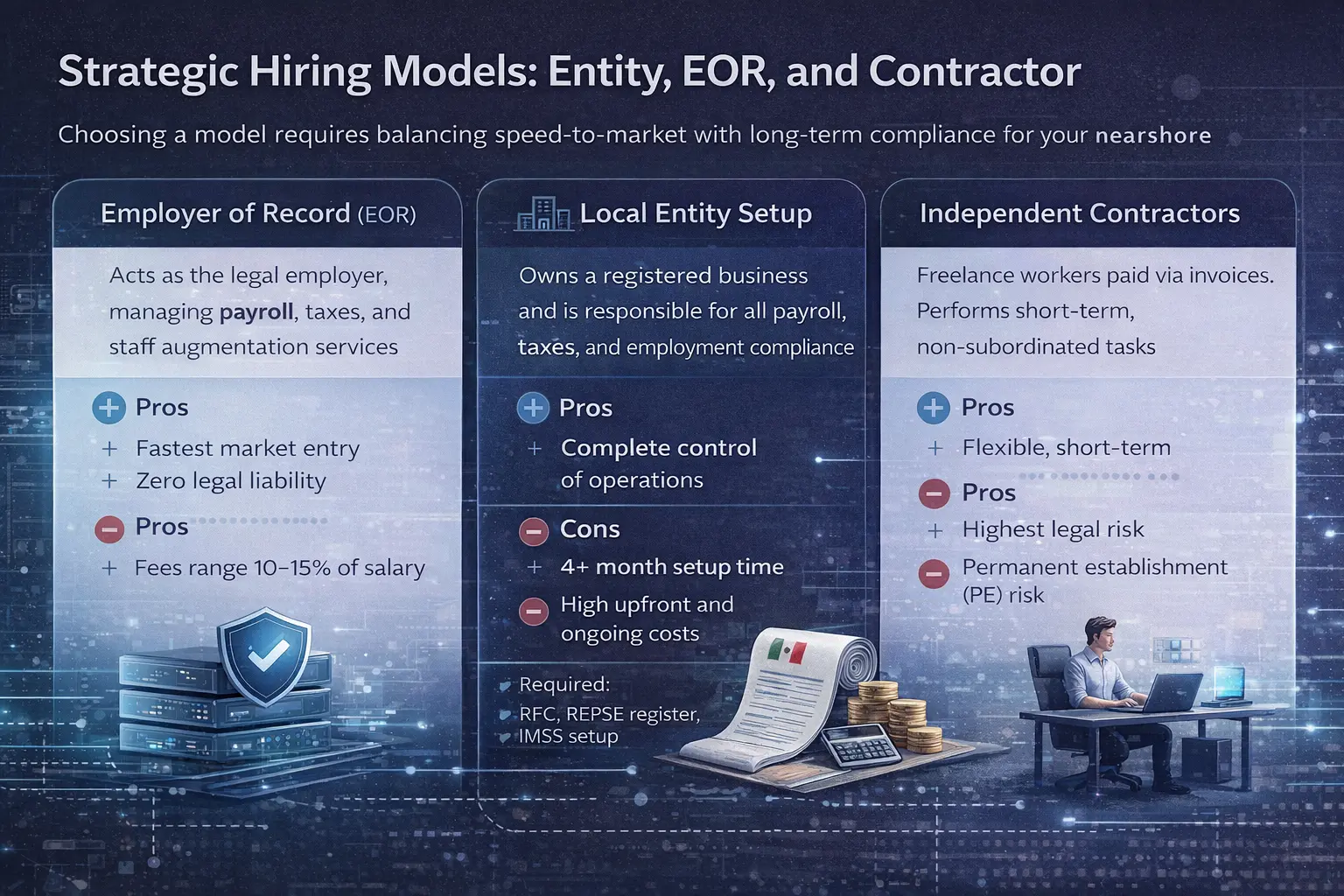
Choosing a model requires balancing speed-to-market with long-term compliance for your nearshore developers.
The Three Primary Models
- Employer of Record (EOR): The "safest and fastest" solution. The EOR acts as the legal employer, managing payroll, taxes, and staff augmentation services, allowing you to hire in days without a local entity.
- Independent Contractors: Highest risk. The 2021 Outsourcing Reform increased audits on misclassified remote developer roles. This should only be used for short-term, non-subordinated tasks.
- Local Entity Setup: Best for large-scale operations (50+ employees). Requires a Mexican Notary, SAT registration for an RFC (Tax ID), and registration with IMSS.
Direct Hiring vs. Staffing Partner
- Direct Hiring (Entity): Offers complete control over internal culture but carries high setup costs and 4+ months of lead time.
- Staffing/EOR Partner: Rapid onboarding, zero legal liability for the foreign parent company, and expert handling of local labor law.
Legal & Compliance: Navigating Federal Labor Law
Mexican software developer compliance is not an optional safeguard; it is a strategic necessity.
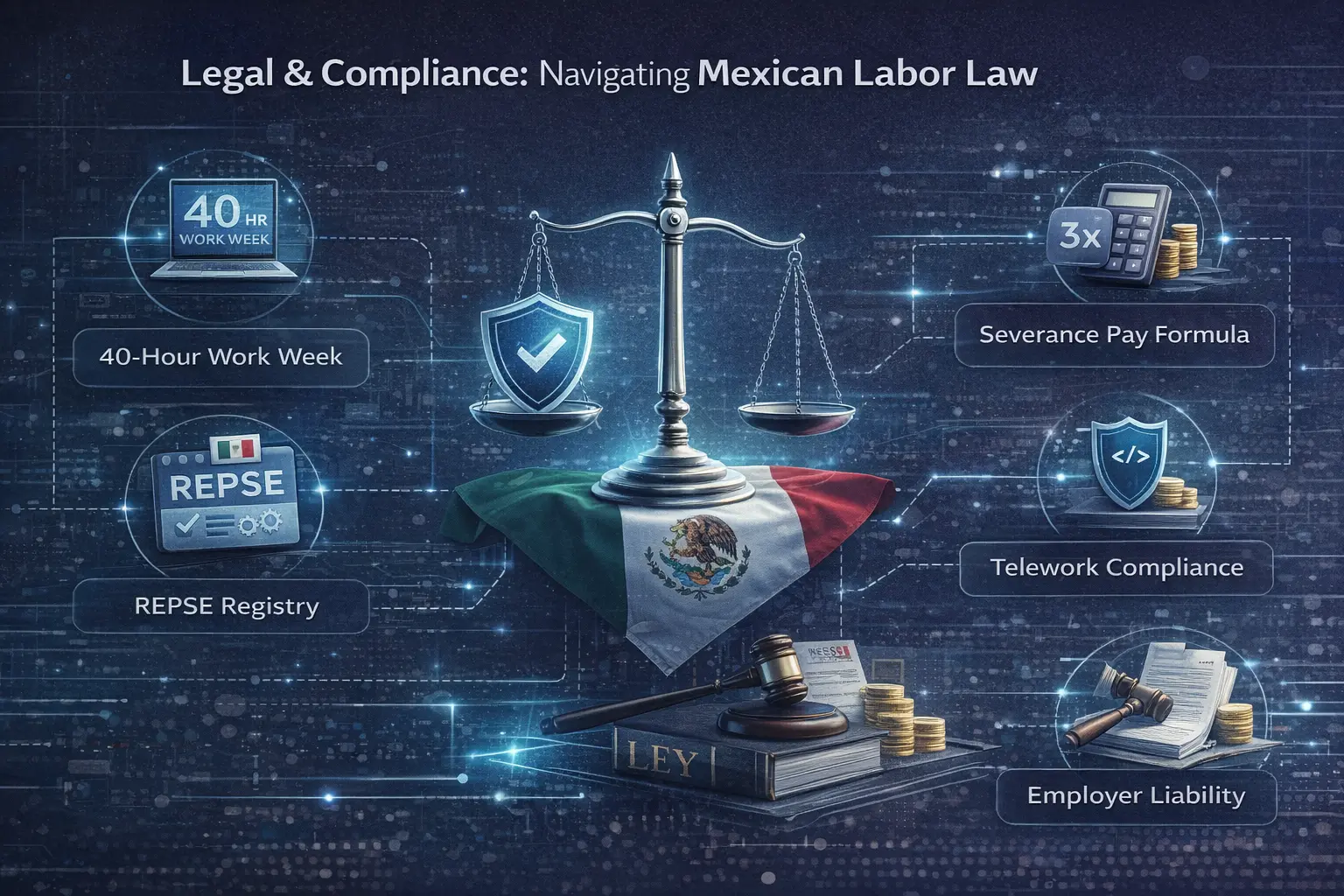
- 2021 Telework Reform: Applies if remote work exceeds 40%. Employers must provide equipment (laptops, ergonomic chairs) and reimburse a proportional part of electricity and internet costs.
- 2021 Outsourcing Reform (REPSE): Strictly prohibits the outsourcing of core business functions. Any third-party partner providing specialized services must be registered in the REPSE registry.
- Severance Formula: Unlike "at-will" employment in the US, termination without cause in Mexico is costly. The mandatory formula is 3 months of salary + 20 days per year of service, plus prorated bonuses (Aguinaldo/Vacation).
- The 40-Hour Work Week: President Claudia Sheinbaum’s update confirmed a gradual reduction from 48 to 40 hours. Implementation begins May 1, 2026, reaching the 40-hour limit by 2030.
Cultural & Operational Realities: The "Nearshore Advantage"
The time zone alignment (UTC-6 to UTC-8) is a primary driver of retention and productivity. Mexico offers total synchronization with US teams, eliminating the "handover lag" common in eastern europe or Asian models.
Real-time synchronization allows for agile ceremonies, pair programming, and emergency troubleshooting to happen within the same business day. Flights from major US hubs (LAX, IAH, JFK) range from 2–5 hours, facilitating high-frequency in-person collaboration.
Common Hiring Challenges and Mitigation Strategies
Despite the opportunity, the market faces a "2 Million Engineer Gap" across IT and manufacturing, driving intense competition for software engineers.
Best Practices for Sourcing and Retention
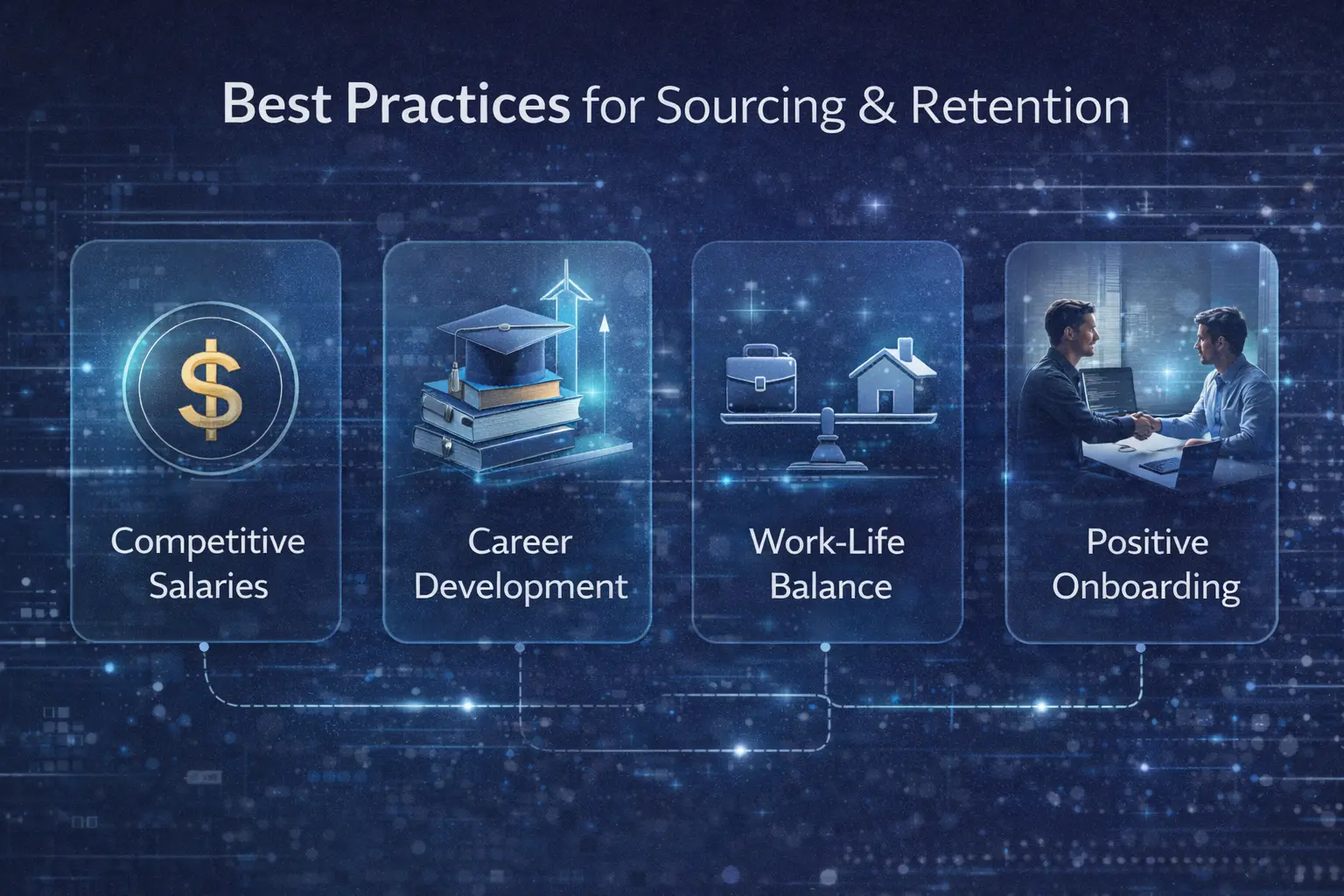
To secure skilled developer talent, a "Global-Standard" candidate experience is the ultimate differentiator.
5-Step Strategic Screening Process
- Sourcing: Broad reach via virtual-first platforms, targeting specialized regional hubs like Guadalajara for fintech or Monterrey for industrial AI.
- Technical Validation: Rigorous technical skills testing on problem-solving, not just syntax. Use live coding sessions to gauge real-time logic.
- Cultural Fit: Assessing adaptability to direct communication and flat hierarchies, especially for teams used to US-style management.
- Compensation Alignment: Ensuring the offer accounts for the 10% PTU and statutory premiums to avoid late-stage candidate drop-off.
- Onboarding: Immediate IMSS registration and delivery of high-end hardware as per Telework Law.
Retention Framework
Successful retention requires a holistic approach:
- Professional Development: Continuous upskilling in AI, Cloud, and leadership for software engineering managers.
- Wellness: Mental health support and private medical insurance.
- Quality Equipment: Providing the hardware and ergonomic setups mandated by the 2021 Telework Reform.
Final Thoughts: Moving from Arbitrage to Partnership
Mexico is no longer a low-cost "backup." It is an R&D powerhouse. For 2026 and beyond, the shift from viewing developers as a "cost center" to a "growth center" will be the hallmark of successful tech expansion. By adhering to local laws and fostering a relationship-based culture, you turn a nearshore project into a permanent competitive advantage. BetterWay Devs offers specialized recruiting in Mexico and staffing for remote roles—contact us to learn more about building your strategic tech team.
Paula Tellez
BetterWay Devs Inbound Marketing Manager
https://www.linkedin.com/in/paula-tellez/
Frequently Asked Questions (FAQ)
- Can I pay in Crypto? Formal FTE employment requires payment in Mexican Pesos (MXN) into a registered Mexican bank account for tax/social security compliance.
- Is the 40-hour week law active yet? The implementation starts May 1, 2026, with a gradual reduction schedule over the next four years.
- What is the "Principle of Subordination"? If you define an individual’s schedule, provide their tools, and supervise their daily work, they are an employee under Mexican law, regardless of a signed "contractor" agreement.
- How does Mexico compare to Costa Rica for tech? While costa rica has high English levels, Mexico offers a significantly larger talent pool and more specialized regional hubs.
Suggested Readings
SAT (Servicio de Administración Tributaria): Official tax and RFC protocols.
IMSS (Instituto Mexicano del Seguro Social): Social security and employer burden tables.
STPS (Ministry of Labor): Updates on Telework Law, REPSE, and the 40-hour week bill.
Software developers in Latin America
Behavioral Interviews for LATAM Developers: What US Companies Really Expect


.png)
