.webp)
Most 2027 engineering budgets were built around a number that doesn't hold up: how long it actually takes to fill a senior seat. Teams plan senior engineering hiring for 2027 the same way they planned it in 2022, and the market underneath that assumption has already moved.
That gap rarely shows up as its own line item. It shows up as a migration that stalls, a platform decision nobody owns, or two mid-level engineers who stay blocked longer than they should because the person meant to unblock them hasn't started yet. The seat is empty for a quarter, maybe two, and the cost gets absorbed quietly into everything downstream of it.
The Cost of Waiting Rarely Gets Named
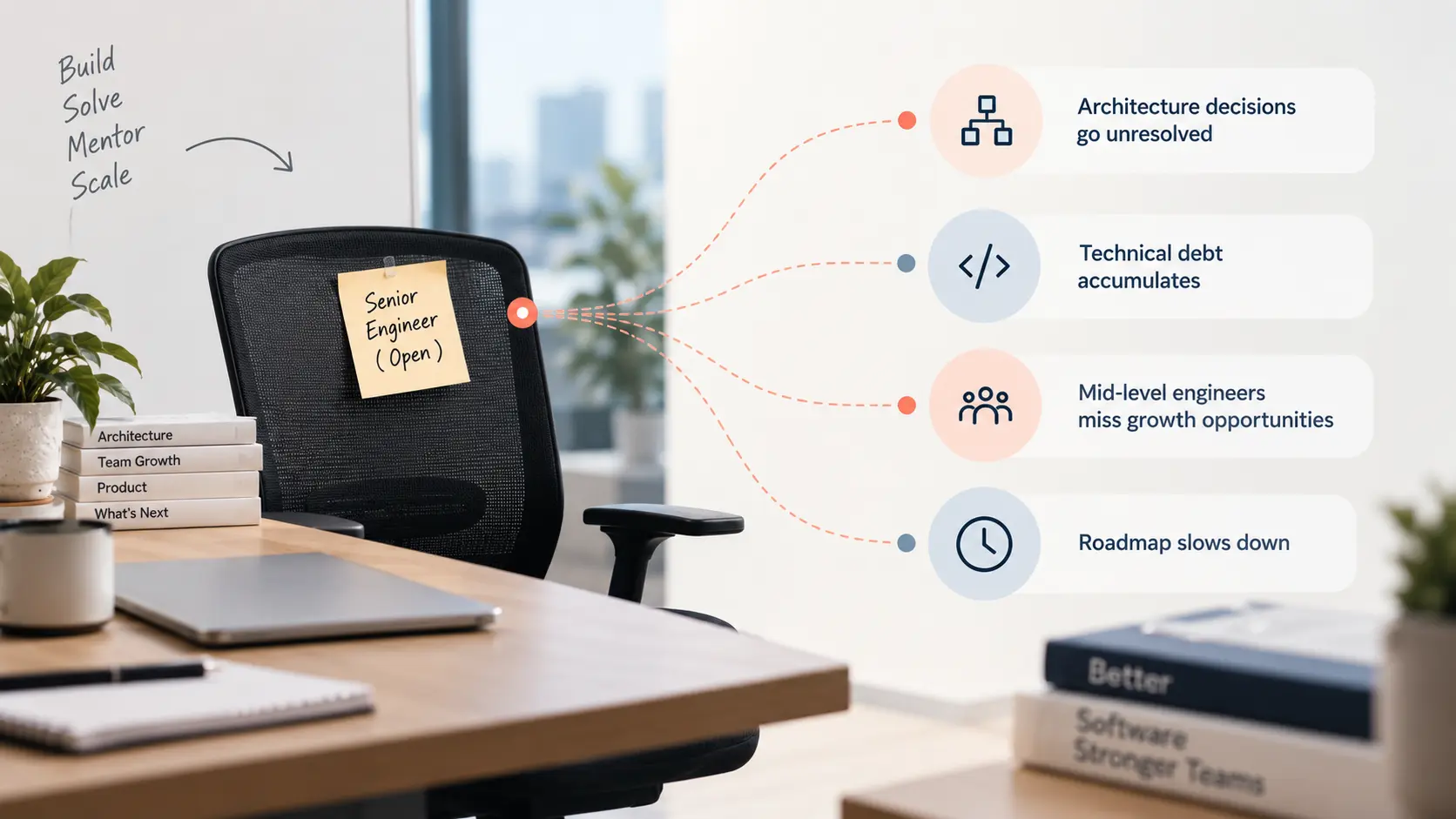
When a senior or staff-level role sits open, the immediate effect is obvious: one fewer engineer on the team. The less obvious effect is what that person was actually there to do.
Senior engineers are rarely hired just to write code faster. They're hired to make architecture calls, review decisions other people are afraid to make alone, and mentor the engineers who would otherwise stay stuck. When that role is vacant, those responsibilities don't pause. They either go undone, or they get absorbed by someone who wasn't budgeted or leveled for that work.
By the time a company notices the pattern, it's already showing up as a slower roadmap, a backlog of unreviewed technical debt, or a couple of good mid-level engineers who are quietly frustrated because nobody senior is available to develop them. None of that gets attributed back to "the senior search took four months longer than planned," but that's usually where it started.
Why This Is a Structural Problem, Not a Seasonal One
It's tempting to describe this as a generic talent shortage. That framing is too vague to act on. What's actually happening is two specific, measurable things compounding at the same time.
The Bar for "Senior" Keeps Rising
Five years of experience and a solid portfolio used to be enough to clear a senior bar. That's no longer the case at most companies. Today, "senior" increasingly means someone who can own architecture decisions with minimal oversight, mentor other engineers without a formal process forcing them to, and make judgment calls in ambiguous situations rather than executing a well-defined ticket.
That's a genuinely narrower profile than "senior" meant even a few years ago, and it narrows the pool of people who qualify faster than the market can produce them.
The Hiring Market Has Split in Two
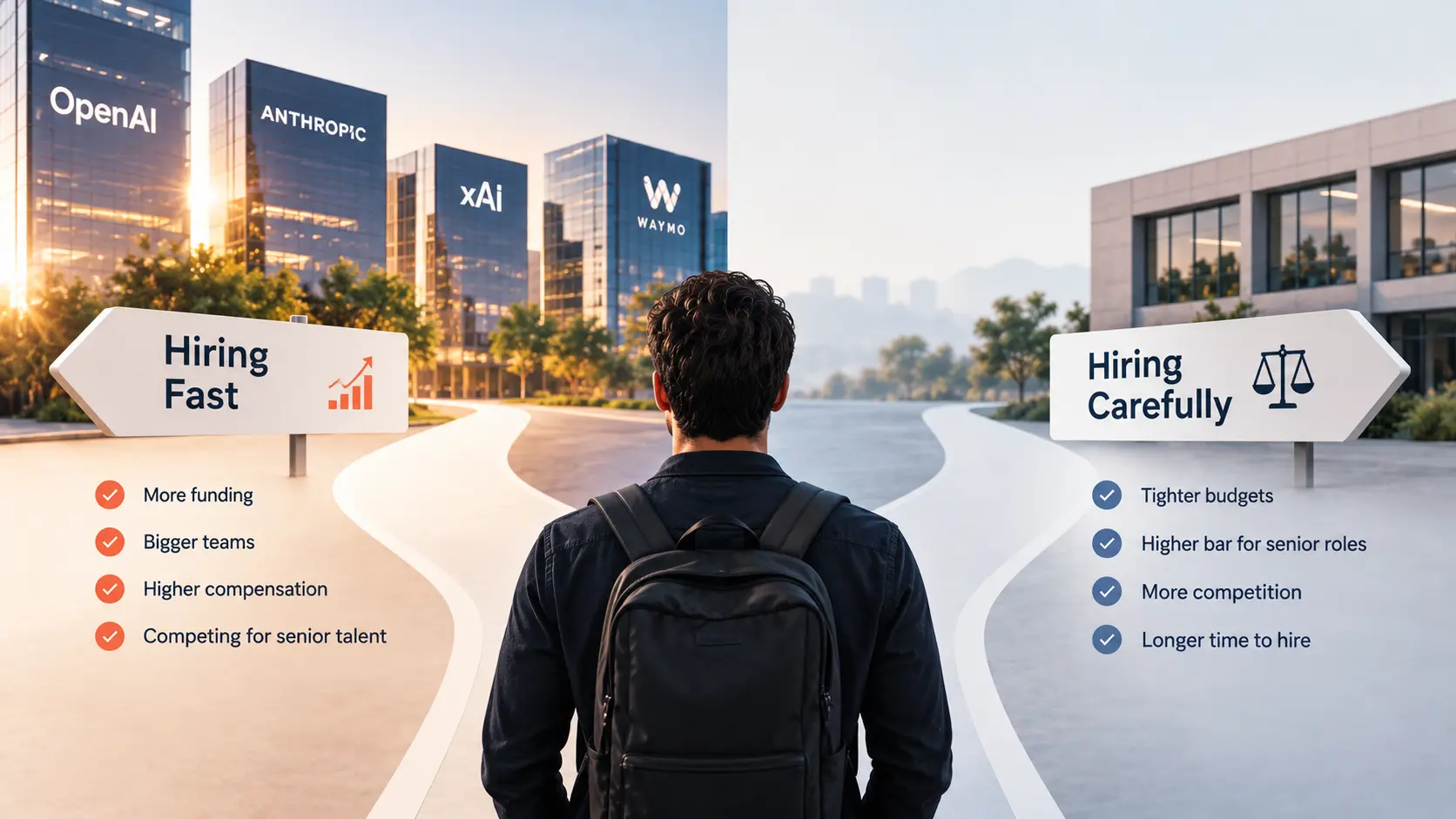
At the same time, tech hiring itself has bifurcated. According to Robert Half's Demand for Skilled Talent research, technology leaders are hiring more aggressively in the second half of 2026 than at any point earlier in the year — more than three-quarters (78%) now plan to increase permanent headcount, up sharply from 61% just months earlier. The same research found that 65% of technology hiring managers say finding skilled talent is harder than it was a year ago.
Layer venture funding on top of that, and the picture gets sharper. Crunchbase's Q1 2026 data shows that four companies alone — OpenAI, Anthropic, xAI, and Waymo — raised a combined $188 billion in a single quarter, or nearly two-thirds of all global venture investment during that period. That capital is concentrated in a narrow band of AI and infrastructure companies that are hiring senior engineering talent aggressively, and often paying at a level most companies can't match on a like-for-like basis.
The result: most engineering teams are competing for the same senior-level candidates as companies who can move faster and pay more, while being asked, in their own budget cycles, to hire more carefully than they did two years ago. That squeeze is structural. It doesn't resolve on its own, and it isn't specific to any one industry or region.
This is also why the underlying research on the talent gap matters more than the number itself. Korn Ferry's Future of Work: The Global Talent Crunch study projects a global shortage of more than 85 million skilled workers by 2030 across technology, financial and business services, and manufacturing combined. It's not a tech-only figure, but it points at the same structural reality: demand for specialized, judgment-heavy roles is outpacing the supply of people qualified to fill them, and that outpacing is measured in years, not hiring cycles.
There's a related pattern worth naming, even without hard numbers attached to it: AI tool adoption among developers is now widespread. Stack Overflow's 2025 Developer Survey found that 84% of respondents are using or planning to use AI tools in their development process, up from 76% the year before, with 51% of professional developers using AI tools daily. That's a genuine shift in how code gets written day to day. What it hasn't done is reduce the need for senior judgment. If anything, it raises the value of the person who can evaluate whether AI-assisted output is actually sound, decide where it fits into an existing system, and catch the places where it quietly doesn't. That's exactly the kind of judgment that's in short supply.
What This Means for How You Plan Headcount
Most nearshore and LATAM staffing content skips past this part and goes straight to a pitch about access to talent. That framing is usually too generic to be useful, but the underlying point is worth being specific about, because it's the actual mechanism at work here.
A local senior search is, by definition, limited to whoever happens to be senior, qualified, and available in one metro area right now. When that search runs long, it's rarely because senior engineers don't exist. It's because the pool the search is actually drawing from is much smaller than it looks, and everyone hiring in that same city, for that same seniority level, is competing for the same narrow slice of people.
Nearshore staffing changes which pool a company is actually choosing from. It doesn't change the bar. A senior engineer sourced across Latin America still needs to clear the same architecture-ownership, judgment, and mentoring standard as a local candidate would. What changes is the size of the population that gets evaluated against that bar, from one city's worth of available senior talent to a regional one. The wait stops being "until the right person happens to show up locally" and becomes "how quickly can we evaluate qualified people who are already available."
That's a pool argument, not a cost argument. The value isn't that nearshore hiring is cheaper than a local senior hire. It's that a company planning 2027 headcount isn't stuck choosing between waiting out a slow local search and lowering its bar to fill the seat faster.
BetterWay Devs works with companies on both sides of that decision. For teams that need a specific senior or specialist skill set for a defined stretch of work, our transparent staffing model brings in a developer with structured local support — benefits, PTO tracking, equipment, ongoing HR care — under a monthly fee with Net 30 terms. For teams building a longer-term core team, direct-hire recruitment focuses on finding someone who fits the role and the team for the long run, with a built-in guarantee period. Either way, the search draws from the same wider regional pool rather than one local market.

Building Capacity Before You Need It
The teams that handle this well aren't the ones with a faster hiring process. They're the ones who stopped treating senior hiring as something that starts when a seat opens.
A few practical shifts help:
- Separate "senior headcount" from "senior hire." Not every stretch of senior-level work needs a permanent local hire. Some needs a defined engagement scoped to the actual project.
- Plan the search timeline against the current market, not last cycle's. If senior searches are running longer than they were two years ago, budget for that reality rather than for how fast it used to move.
- Decide what "senior" actually means for the role before sourcing starts. Vague seniority bars widen the search and slow it down. Specific ones narrow it to people who can actually clear it.
- Widen the pool before widening the search effort. If a local search is running long, the fix usually isn't more sourcing hours in the same market. It's evaluating candidates against the same bar from a larger pool.
None of this eliminates the underlying scarcity. It just means a company isn't discovering the problem the same week a critical migration is supposed to start.

The Practical Next Step
None of this is a case for rushing a senior hire. It's a case for starting the conversation about pool and model before the seat opens, not after the search has already been running for a quarter. If you want a closer look at how staffing, direct-hire, and other models compare for senior and specialist roles specifically, our guide to hiring specialized tech talent walks through the trade-offs in more depth.
And if you're currently mid-planning for 2027 headcount, a short conversation is usually enough to tell whether a wider regional search actually helps with the specific roles on your list. BetterWay Devs is a nearshore IT recruiting and staffing company connecting software engineers across Latin America with technology companies in the United States. With more than 16 years of experience building distributed engineering teams, we help companies match the hiring model to the actual shape of the work, not the other way around.
Frequently Asked Questions
Why is senior engineering hiring taking longer in 2026 and 2027? Senior searches are running longer because two things are compounding at once: the bar for "senior" now typically requires architecture ownership and independent judgment rather than just years of experience, and hiring demand has split, with a small number of heavily funded AI companies competing aggressively for the same senior profile most other companies also need.
Is the tech talent shortage really 85 million people by 2030? That figure comes from Korn Ferry's Future of Work: The Global Talent Crunch research, and it spans technology, financial and business services, and manufacturing combined, not technology alone. It's best understood as directional evidence of a broad, structural skills gap rather than a tech-specific headcount number.
How much of recent venture funding is going to a small number of AI companies? According to Crunchbase, four companies — OpenAI, Anthropic, xAI, and Waymo — raised a combined $188 billion in Q1 2026 alone, close to two-thirds of all global venture investment for that quarter. That concentration is part of why senior engineering talent is being pursued so aggressively by a narrow band of well-funded companies.
Does nearshore staffing help with senior-level hiring specifically, or mainly entry-level roles? Nearshore staffing is often associated with junior or mid-level roles, but it applies just as directly to senior and specialist hiring. It widens the pool a senior search draws from, from one local market to a regional one, while holding candidates to the same seniority bar.
What should a company do if it's already behind on its 2027 senior hiring plan? Start by asking whether the search is actually constrained by candidates who don't exist, or by a pool that's limited to one metro area. If it's the second, widening the search to a regional talent pool, evaluated against the same bar, is usually faster than continuing to source locally.


.png)
