.webp)
Why Most Companies Fail at Nearshore Developer Onboarding
You've hired a talented nearshore developer from Latin America. The contracts are signed, the start date is set, and expectations are high. But here's the reality: 60% of nearshore engagements fail in the first 90 days—not because of technical skills, but because of onboarding failures.
The difference between a nearshore developer who contributes meaningfully in week two versus one who struggles for months comes down to one thing: a structured onboarding process.
This comprehensive guide provides the exact framework successful companies use to onboard nearshore developers effectively. We'll show you what to do before day one, how to structure the first eight weeks, and which responsibilities fall on your team versus your staffing partner.
What you'll learn:
- A week-by-week onboarding timeline with specific actions
- Technical setup requirements and tools configuration
- Communication protocols for distributed teams
- Success metrics to track progress
- Common failure modes and how to avoid them
- Downloadable checklists for your entire team
Let's get started.
Understanding the Nearshore Developer Onboarding Challenge
Why Nearshore Onboarding Is Different
Onboarding a nearshore developer isn't the same as onboarding a local hire. You're navigating:
Time Zone Considerations: Even with 2-4 hours of overlap, asynchronous communication becomes critical. Your developer works when some of your team is offline, requiring different coordination strategies.
Cultural Integration: Latin American work cultures emphasize relationship-building and context. Developers from Colombia, Mexico, or Argentina may approach problem-solving differently than your US-based team.
Remote-First Challenges: Without hallway conversations or desk drop-bys, you need intentional communication structures. What happens organically in an office requires planning remotely.
Tool Access & Security: Setting up VPNs, GitHub access, AWS permissions, and development environments across borders introduces complexity many teams underestimate.
Relationship Building at Distance: Trust and rapport develop slower remotely. Your nearshore developer needs explicit inclusion in team culture, not just task assignments.
.webp)
The Cost of Poor Onboarding
When nearshore developer onboarding fails, the consequences compound quickly:
- 3-6 months of lost productivity: A poorly onboarded developer operates at 40-50% capacity for months
- $15,000-$30,000 in sunk costs: Between recruitment fees, training time, and management overhead
- Team morale impact: Your existing team wastes hours answering the same questions or fixing mistakes
- Damaged relationships: If you churn through nearshore developers, your staffing partner relationship suffers
- Missed deadlines: Projects slip while you scramble to get developers productive
The good news? A structured 8-week onboarding process reduces time-to-productivity by 60% and increases first-year retention by 40%.
The 8-Week Nearshore Developer Onboarding Framework
This framework divides onboarding into five distinct phases, each with specific objectives, actions, and success metrics. Use this as your roadmap.
Framework Overview
Let's break down each phase in detail.
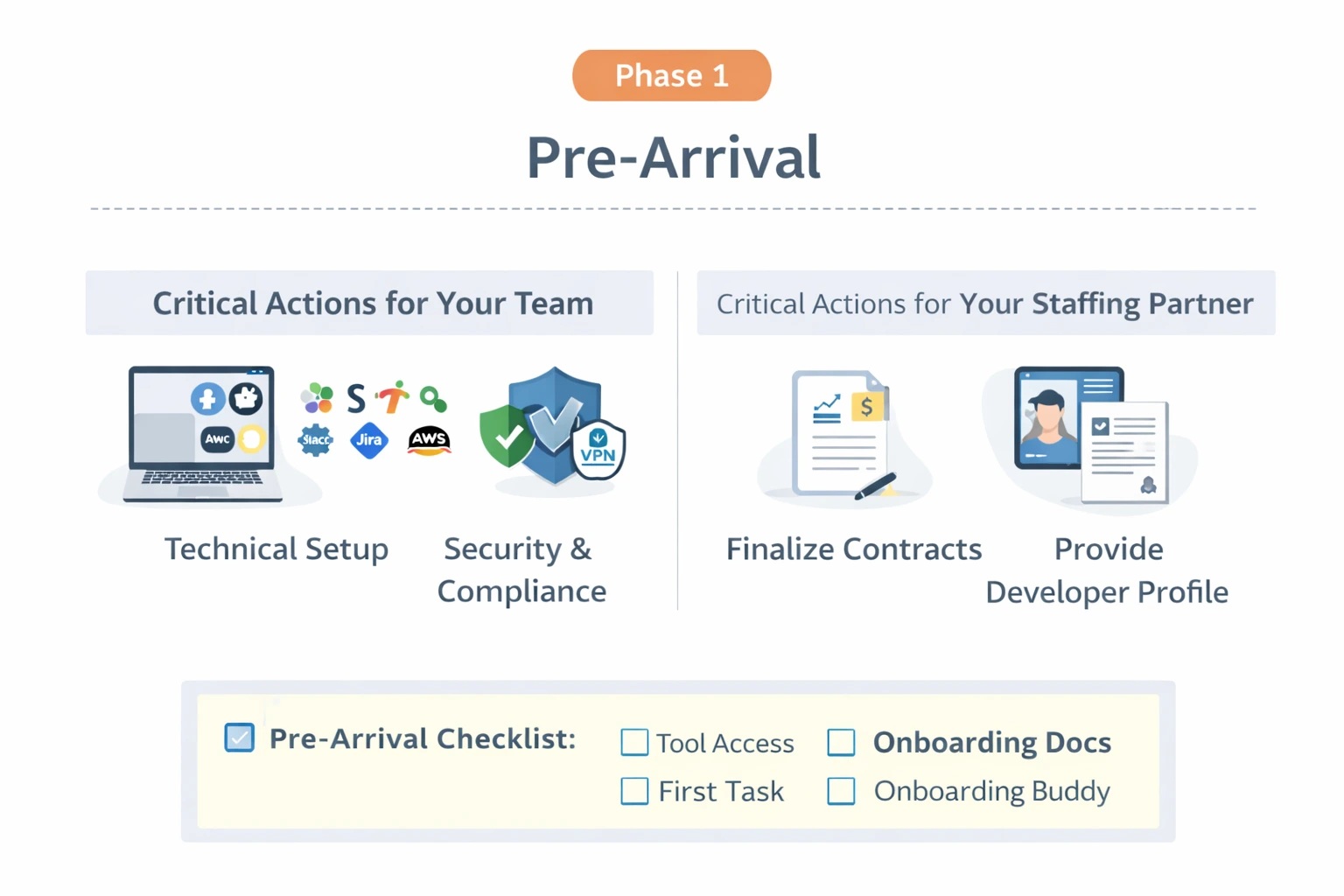
Phase 1: Pre-Arrival (Week -1)
Primary Goal: Remove all technical and logistical blockers before day one
The worst onboarding experiences start with a developer staring at a blank screen on day one, waiting for access to tools, credentials, or documentation. The best start with everything ready to go.
Critical Actions for Your Team
1. Technical Setup (Complete Before Day One)
Create accounts and grant access for:
- Version control: GitHub, GitLab, or Bitbucket organization access with appropriate repository permissions
- Project management: Jira, Linear, Asana, or Trello with visibility into relevant boards
- Communication tools: Slack workspace invite (including private channels), Microsoft Teams access
- Development tools: AWS/GCP/Azure credentials, database access (read-only initially), staging environment access
- Documentation: Confluence, Notion, or internal wiki with onboarding documentation
- CI/CD tools: Access to deployment pipelines, monitoring dashboards (DataDog, New Relic)
- Design tools: Figma, Sketch, or similar (for frontend/full-stack developers)
2. Security & Compliance
- VPN setup: Provide VPN credentials and setup instructions specific to their operating system
- 2FA configuration: Document your 2FA requirements (Authy, Google Authenticator, hardware keys)
- NDA/IP agreements: Work with your staffing partner to ensure legal agreements are finalized
- Security training: Schedule a security overview session for week one
3. Documentation Preparation
Create or update these critical documents:
- Architecture overview: High-level system design, key services, technology stack
- Development environment setup guide: Step-by-step instructions for local development
- Coding standards: Style guides, linting rules, code review expectations
- Git workflow: Branch naming, commit message format, pull request process
- Deployment process: How code moves from local → staging → production
- Common troubleshooting: FAQ for environment setup issues
4. Team Preparation
- Assign an onboarding buddy: Choose a mid-to-senior developer who'll be the new hire's go-to person
- Block calendars: Reserve time in key people's calendars for intro meetings (avoid "too busy" syndrome)
- Announce the new hire: Send a team announcement with the developer's background, start date, and role
- Prepare the first task: Identify a well-scoped, meaningful first ticket (not "update README" busywork)
Critical Actions for Your Staffing Partner
At BetterWay Devs, we handle the administrative foundation during pre-arrival:
- Contract finalization: Employment agreements, work terms, intellectual property clauses
- Benefits enrollment: Health insurance, vacation policy, payment schedule
- Company presentation: We provide your company with a comprehensive candidate profile document including professional background, technical expertise, communication preferences, and personal context to help you understand who you're working with
- Administrative setup: Payroll systems, time tracking tools, compliance documentation
Transparency note: Your staffing partner handles the legal and administrative foundation, but you own the technical and cultural onboarding. This division ensures developers can work legally and get paid correctly while you focus on making them productive and integrated.
Pre-Arrival Checklist
Use this checklist to ensure nothing falls through the cracks:
- [ ] All tool accounts created and tested
- [ ] VPN credentials provided and verified
- [ ] Onboarding documentation reviewed and updated
- [ ] First task identified and described in project management tool
- [ ] Onboarding buddy assigned and briefed
- [ ] Team announcement sent
- [ ] Calendar holds for week one meetings confirmed
- [ ] Welcome email drafted (to be sent day before start date)
- [ ] Contracts and benefits finalized by staffing partner
- [ ] Candidate profile document received and reviewed
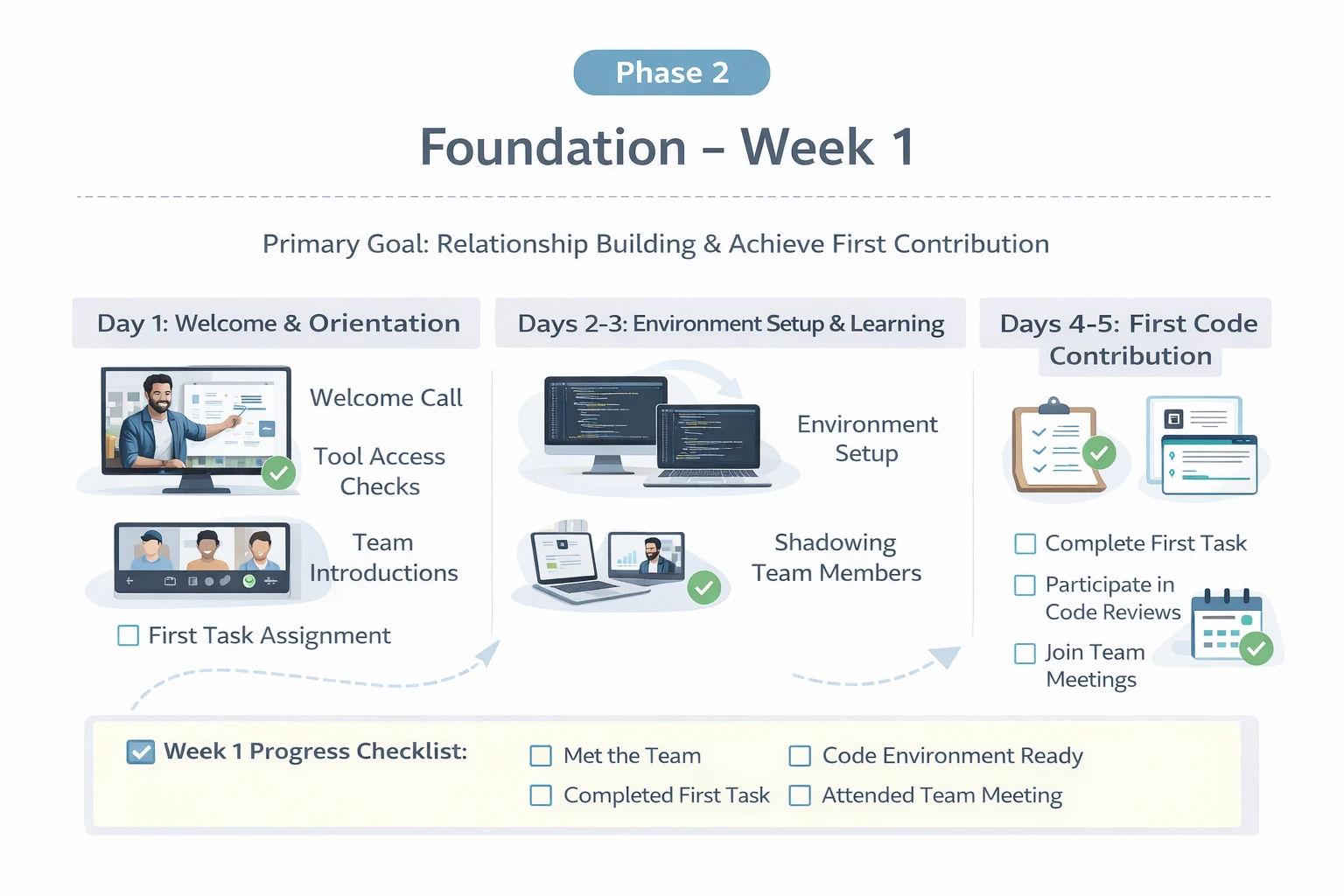
Phase 2: Foundation - Week 1
Primary Goal: Establish relationships, provide context, and achieve first contribution
Week one sets the tone for the entire relationship. Your developer should feel welcomed, not overwhelmed. The goal isn't maximum productivity—it's building the foundation for long-term success.
Day 1: Welcome & Orientation
Morning (First 2-3 Hours)
9:00 AM - Welcome Call (30 minutes)
- Host: Hiring manager or team lead
- Agenda: Personal introduction, excitement about having them on board, overview of week one schedule
- Goal: Make them feel genuinely welcomed, not like another contractor
9:30 AM - Tool Access Verification (60 minutes)
- Developer tests access to all systems
- Onboarding buddy is available for troubleshooting
- Goal: Fix any access issues immediately (they will exist—count on it)
10:30 AM - Company Context (30 minutes)
- Host: Founder, CTO, or senior leader
- Agenda: Company mission, product vision, why this role matters, how nearshore team fits into the bigger picture
- Goal: Provide meaning beyond "here's your ticket backlog"
Afternoon (After Lunch)
2:00 PM - Team Introductions (45 minutes)
- Meet the immediate team (engineers, product, design)
- Each person shares: name, role, what they're working on, one interesting fact
- Goal: Put faces to names, understand team structure
3:00 PM - Technical Walkthrough (60 minutes)
- Host: Onboarding buddy or tech lead
- Agenda: Codebase architecture, key repositories, development environment setup walkthrough
- Goal: Orientation, not mastery—show them the map, not every street
4:00 PM - First Task Assignment (30 minutes)
- Review the pre-selected first task together
- Ensure they understand requirements, acceptance criteria, and who to ask for help
- Goal: Set them up to make their first contribution by end of week
Days 2-3: Environment Setup & Learning
Primary Activities:
- Environment setup: Get local development environment running, run tests, build the application
- Documentation exploration: Read architecture docs, understand system design, review past decisions
- Shadowing: Observe a code review, sit in on a standup, watch a demo
- First code changes: Make a small, low-risk change (fix a typo, update a config, improve a comment)
Communication Protocol:
- Daily check-ins: 15-minute sync with onboarding buddy at the start of their workday (your afternoon if they're 3 hours behind)
- Slack responsiveness: Someone on your team should be explicitly responsible for answering questions quickly
- Encouragement to ask: Explicitly tell them "we expect questions—it's a sign you're engaged, not a sign you're struggling"
Days 4-5: First Meaningful Contribution
Primary Activities:
- Complete first task: Finish the assigned ticket, open a pull request, address code review feedback
- Code review participation: Review someone else's pull request (with guidance)
- Team meeting participation: Join sprint planning, backlog grooming, or team retrospective
Success Milestone: By end of week one, your nearshore developer should have:
- [ ] Successfully accessed all required tools
- [ ] Set up local development environment
- [ ] Made at least one code commit (even if small)
- [ ] Met every member of the immediate team
- [ ] Understood the product and company mission
- [ ] Participated in at least one team meeting
- [ ] Identified their onboarding buddy and knows how to ask for help
Week 1 Communication Tips for Distributed Teams
Synchronous Time Usage: Use your 2-4 hours of time zone overlap wisely:
- Best for: High-bandwidth discussions, brainstorming, pair programming, clarifying ambiguity
- Not for: Status updates, FYI announcements, information dumps (use async tools instead)
Asynchronous Communication Excellence:
- Over-communicate context: "Here's what I'm working on, here's where I'm stuck, here's what I've tried" beats "How do I fix this?"
- Use video: Screen recordings (Loom, Jam) are 10x better than paragraphs of text for technical explanations
- Document decisions: Slack discussions disappear. Move decisions to GitHub, Confluence, or Notion.
- Set response time expectations: "I'll respond within 3 hours during overlap" gives clarity
Avoid These Week One Mistakes:
- ❌ Assigning a massive, ambiguous task and expecting them to figure it out alone
- ❌ Assuming they'll interrupt you if they're stuck (they won't—cultural norms differ)
- ❌ Treating them like a code-writing robot instead of a team member
- ❌ Overloading them with 47 tools, 12 meetings, and zero time to process
- ❌ Canceling meetings because "you're too busy" (this signals they're not a priority)
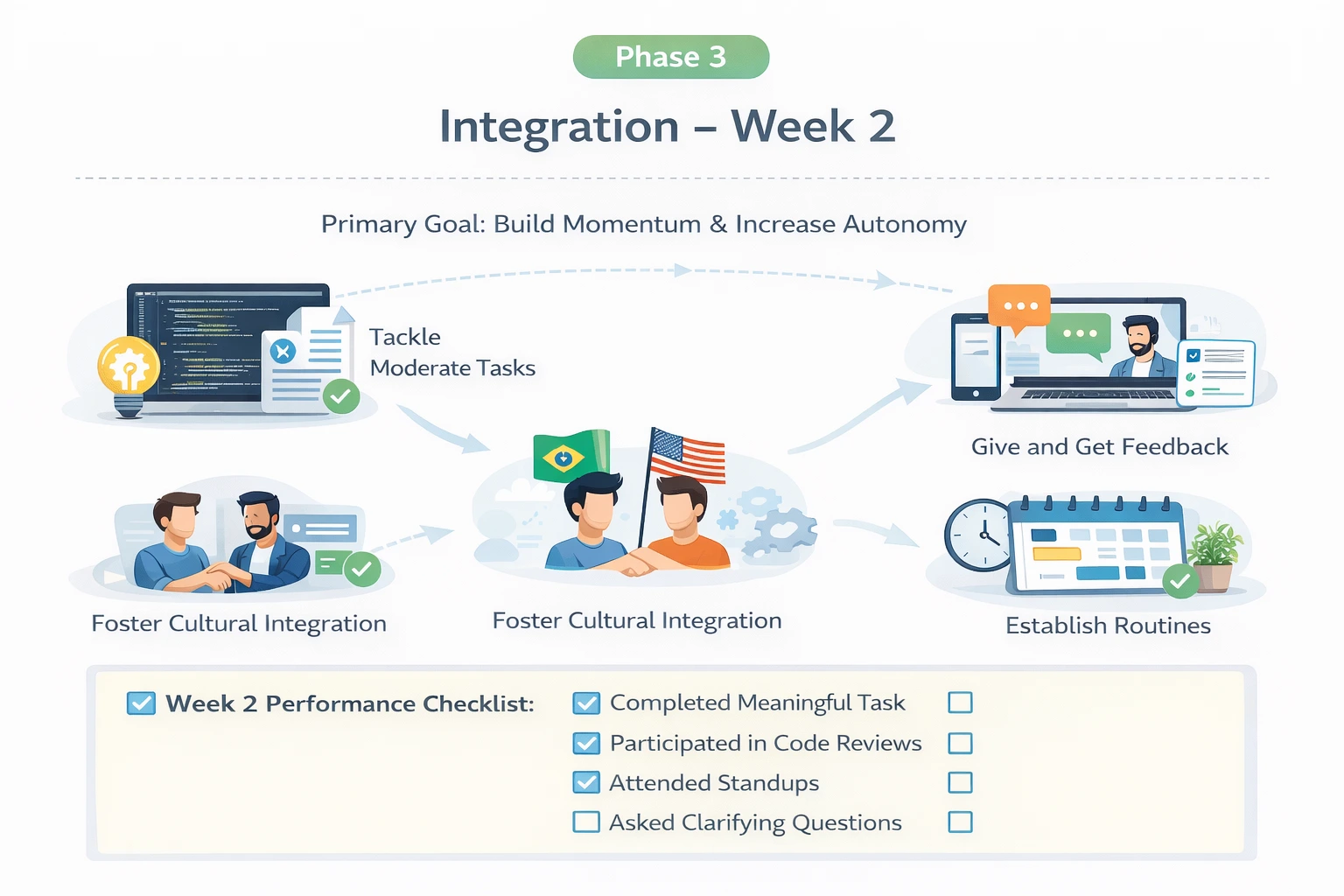
Phase 3: Integration - Week 2
Primary Goal: Build momentum, increase autonomy, and establish working rhythms
Week two is where the transition from "new person" to "team member" accelerates. They've got context from week one—now it's time to contribute meaningfully.
Key Activities
1. Increase Task Complexity (Gradually)
Move from "fix a typo" to "build a small feature" or "investigate a bug":
- Assign a task that requires 3-5 days of work
- Ensure the task has clear requirements but allows some design autonomy
- Provide a definition of done, not a step-by-step implementation guide
Good Week 2 Task Examples:
- Implement a new API endpoint with tests
- Fix a well-documented bug that requires understanding system behavior
- Add validation logic to an existing form
- Refactor a component to improve maintainability
Bad Week 2 Task Examples:
- Build a complex, ambiguous feature with unclear requirements
- Investigate a mysterious production issue with zero context
- Refactor a critical system that requires deep tribal knowledge
2. Code Review Participation (Both Directions)
Reviewing their code:
- Focus on teaching, not gatekeeping
- Explain why you're suggesting changes (link to style guides, architectural principles)
- Pair program through complex feedback instead of leaving cryptic comments
- Celebrate good practices: "Great test coverage here!" builds confidence
Having them review others' code:
- Start with smaller, low-risk PRs
- Encourage questions: "What's the reasoning behind this approach?" is a great code review comment
- Frame it as learning: "We review each other's code to share knowledge, not to police"
3. Establish Recurring Touchpoints
By week two, these meetings should be scheduled:
- Daily standups: Brief sync on progress, blockers, and plan for the day
- Weekly 1-on-1 with manager: 30 minutes to discuss progress, challenges, career goals
- Bi-weekly sprint planning: Include them in story estimation and sprint commitment discussions
- Ad-hoc pairing sessions: Schedule pair programming when tackling complex problems
4. Cultural Integration Efforts
Don't neglect the social side:
- Informal virtual coffee: Schedule a casual 15-minute chat with no agenda (yes, this matters)
- Team channel participation: Encourage them to engage in non-work Slack channels
- Share personal context: When appropriate, share life updates, weekend plans, interests (models openness)
Week 2 Success Metrics
By the end of week two, your developer should:
- [ ] Independently complete a meaningful task (3-5 day scope)
- [ ] Participate actively in code reviews (both giving and receiving)
- [ ] Attend and contribute to team meetings without prompting
- [ ] Ask clarifying questions when requirements are ambiguous
- [ ] Demonstrate understanding of your git workflow and deployment process
- [ ] Begin building rapport with team members beyond just their onboarding buddy
Managing Week 2 Challenges
Common Challenge: "They're not asking enough questions"
Latin American work cultures often emphasize not being a burden or bothering busy people. Your developer might struggle in silence rather than interrupt.
Solutions:
- Schedule explicit "ask me anything" time blocks where questions are expected
- Create a safe "dumb questions" Slack channel where any question is welcomed
- Model question-asking behavior: "I don't know either—let's figure it out together"
- Use your 1-on-1 to explicitly ask: "What's confusing? Where are you stuck?"
Common Challenge: "They're moving slower than I expected"
Reality check: Even senior developers need 3-4 weeks to reach 50% productivity in a new codebase.
Solutions:
- Adjust expectations: Week two isn't about speed, it's about trajectory
- Identify blockers: Are they actually slow, or are your processes (slow CI/CD, unclear requirements, lack of documentation) slowing them down?
- Pair program: Sitting with them (virtually) for an hour reveals where friction exists
- Celebrate progress: "You shipped X this week—that's great momentum" reinforces growth
Common Challenge: "They're not meshing with the team culture"
Building relationships remotely takes longer. What happens organically in an office requires intention online.
Solutions:
- Host a virtual team lunch (yes, eating on video together helps)
- Create opportunities for non-work connection: gaming sessions, book clubs, fitness challenges
- Rotate who they pair with: Exposure to different team members accelerates integration
- Acknowledge cultural differences: Discuss communication styles openly ("In your experience, how do teams typically handle disagreements?")
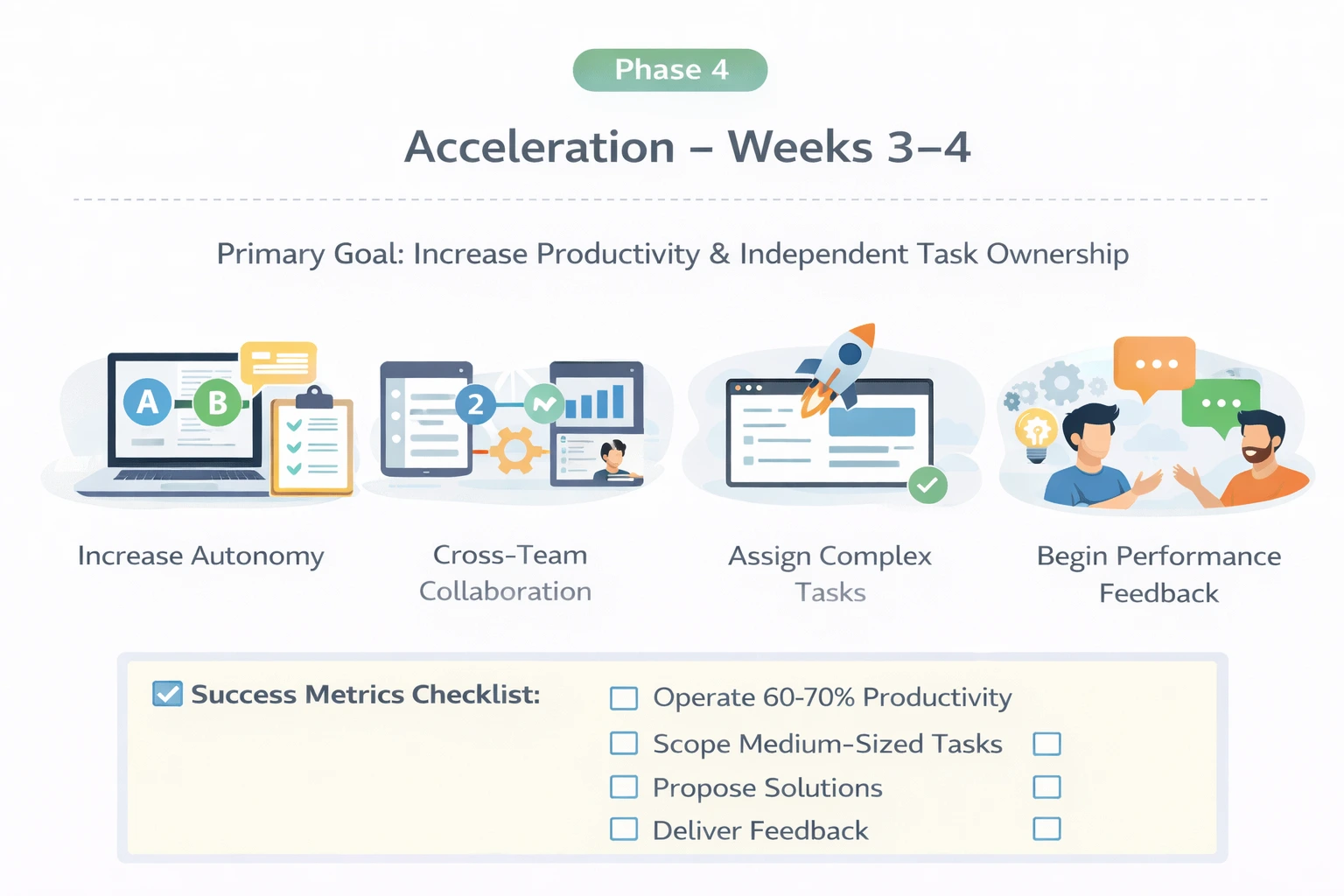
Phase 4: Acceleration - Weeks 3-4
Primary Goal: Achieve 60-70% productivity and independent task ownership
By week three, your nearshore developer should be operating semi-independently. They know the codebase, understand your processes, and contribute without constant hand-holding.
Key Activities
1. Increase Autonomy
Shift from "here's exactly what to do" to "here's the problem to solve":
- Assign tasks with clear outcomes but flexible implementation
- Let them propose solutions before dictating approaches
- Involve them in technical design discussions
- Give them small decisions to own ("which library should we use for this?")
2. Expose Them to Cross-Functional Work
Don't silo them in just coding:
- Product discussions: Include them when refining requirements or debating feature priorities
- Design collaboration: Have them work directly with designers on implementation feasibility
- Bug triage: Teach them how to investigate production issues, read logs, and use monitoring tools
- Customer empathy: If possible, expose them to customer feedback, support tickets, or user research
3. Introduce Complex Tasks
Assign work that requires:
- Multi-day or multi-week commitment
- Understanding of business logic, not just code syntax
- Coordination with other team members
- Tradeoff analysis (performance vs. maintainability, speed vs. thoroughness)
4. Begin Performance Feedback
Start providing specific, actionable feedback:
- What's going well: "Your test coverage has been excellent. This helps the whole team move faster."
- What to improve: "I've noticed PRs often lack context in the description. Here's a template that helps reviewers."
- Career development: "You seem interested in infrastructure. Want to shadow me during the next deployment?"
Weeks 3-4 Success Metrics
By the end of week four, your developer should:
- [ ] Operate at 60-70% of full productivity (completing tasks at reasonable pace)
- [ ] Independently scope and break down medium-sized tasks
- [ ] Proactively identify and communicate blockers without prompting
- [ ] Participate actively in technical discussions and propose solutions
- [ ] Provide valuable code review feedback to teammates
- [ ] Understand not just how your systems work, but why they're designed that way
- [ ] Build genuine working relationships with multiple team members
The Month-One Retrospective
At the end of week four, schedule a dedicated onboarding retrospective:
Questions to ask your new developer:
- What went well in your first month?
- What was confusing or frustrating?
- What would you change about the onboarding process?
- Do you have the context and tools you need to succeed?
- How can I support you better as a manager?
- On a scale of 1-10, how integrated do you feel with the team?
Questions for your team:
- How's the new developer integrating?
- What could we do better in future onboardings?
- Are there knowledge gaps we need to address?
- Is the workload distribution appropriate?
Use this feedback to refine your process for the next nearshore developer hire.
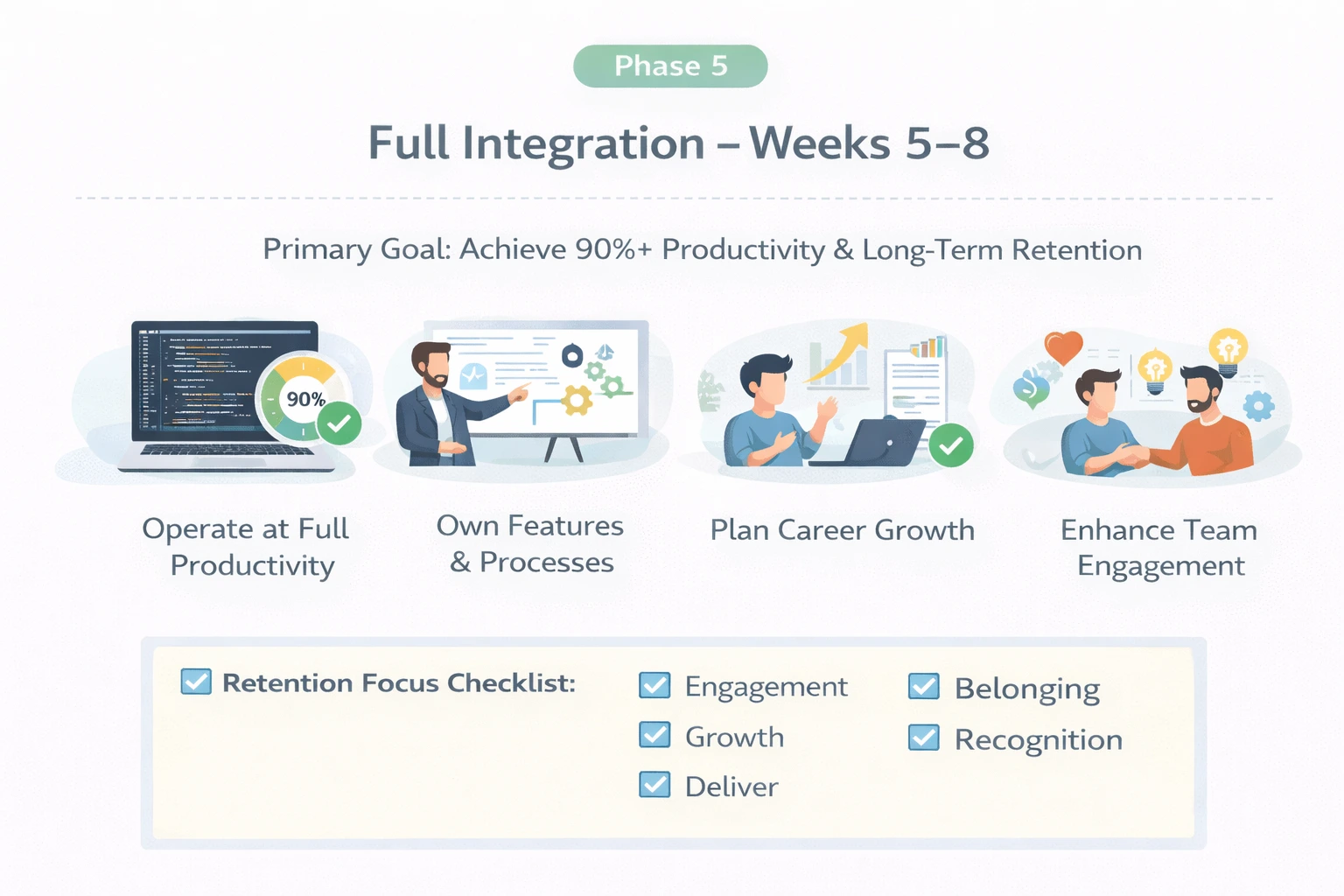
Phase 5: Full Integration - Weeks 5-8
Primary Goal: Achieve 90%+ productivity and long-term retention
Weeks five through eight focus on cementing the relationship, achieving full productivity, and setting up long-term success. The goal is transitioning from "probationary new hire" to "trusted team member."
Key Activities
1. Full Productivity Expectations
By week six, expect:
- Completing tasks at the same pace as mid-level team members
- Independently handling ambiguity and making reasonable decisions
- Contributing to architectural discussions and technical strategy
- Mentoring future new hires (even just through documentation improvements)
2. Ownership and Responsibility
Assign areas of ownership:
- Feature ownership: "You're the primary developer for the authentication system."
- Process ownership: "You're responsible for improving our API documentation."
- Cross-team collaboration: "You'll work with the data team on this integration."
3. Career Development Conversations
Shift from onboarding to growth:
- Discuss 6-month and 12-month goals
- Identify skill gaps and create learning plans
- Explore interests: "Do you want to go deeper on backend, or explore frontend?"
- Connect their work to career progression
4. Retention Focus
The 90-day mark is critical for retention. Proactively address:
- Engagement: Do they feel excited about the work, or just going through motions?
- Belonging: Do they feel like a valued team member, or an outsider?
- Growth: Do they see a path forward, or is this just a job?
- Recognition: Have you explicitly thanked them for their contributions?
Weeks 5-8 Success Metrics
By the end of week eight, your developer should:
- [ ] Operate at 90%+ productivity compared to established team members
- [ ] Own features or systems end-to-end with minimal oversight
- [ ] Proactively identify and solve problems without being asked
- [ ] Mentor or support newer team members
- [ ] Participate in strategic technical discussions
- [ ] Feel genuinely integrated into team culture
- [ ] Express commitment to staying long-term
The 90-Day Check-In
At the end of week 8-12, conduct a formal performance review:
Assessment Areas:
- Technical execution: Code quality, task completion, problem-solving ability
- Communication: Responsiveness, clarity, proactive updates
- Collaboration: Code reviews, teamwork, conflict resolution
- Growth: Learning velocity, adaptability, initiative
- Cultural fit: Alignment with values, team cohesion, engagement
Key Questions:
- Are they meeting the expectations set in the job description?
- Would you confidently expand their responsibilities?
- Are there any concerns about long-term fit?
- What development areas should they focus on next?
If the answer to "Would I want to work with this person long-term?" is yes, invest heavily in retention. If it's no, address issues transparently and quickly.
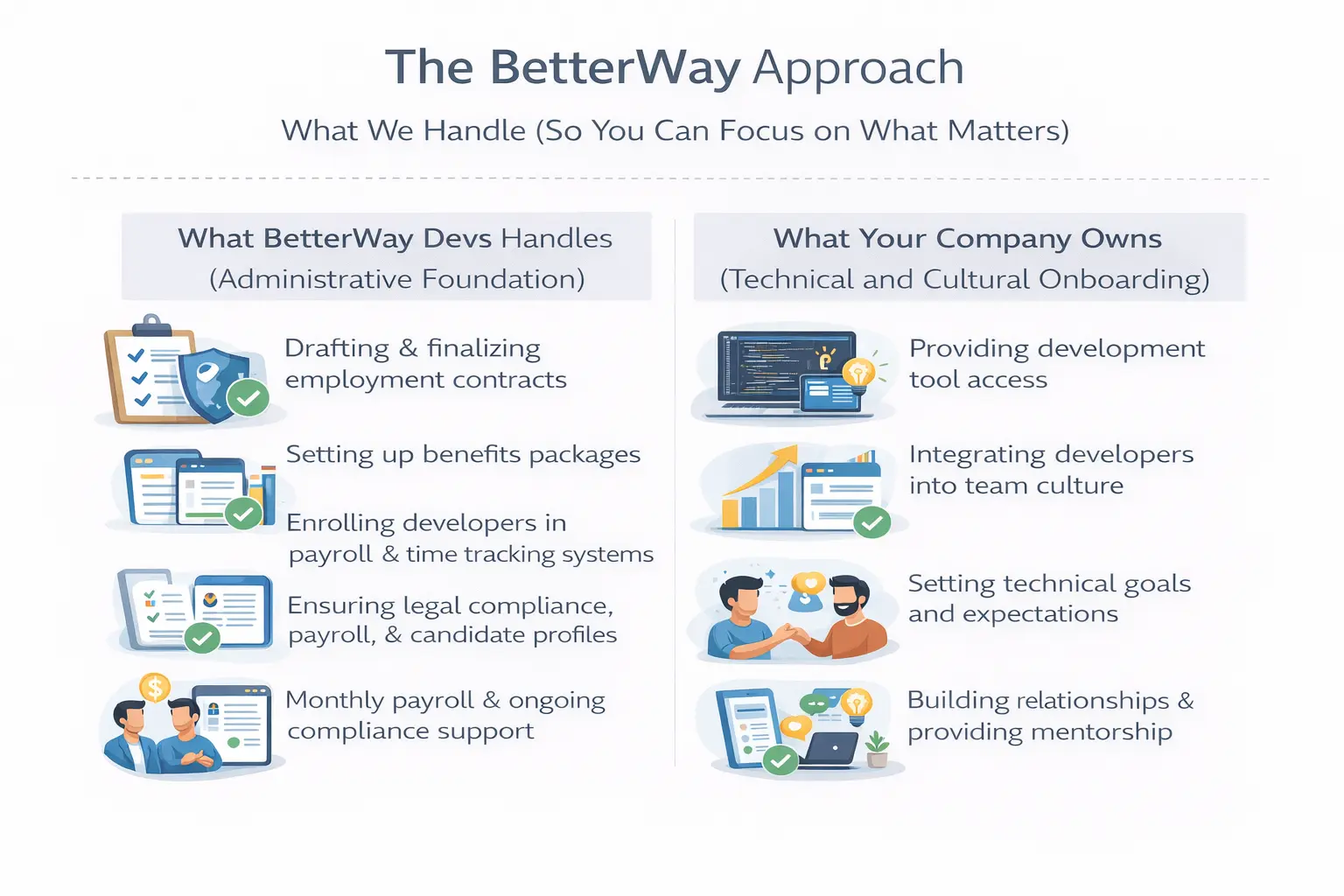
The BetterWay Approach: What We Handle (So You Can Focus on What Matters)
At BetterWay Devs, we believe transparency creates successful partnerships. Here's exactly what we handle versus what your team owns during nearshore developer onboarding.
What BetterWay Devs Handles (Administrative Foundation)
Pre-Onboarding:
- Drafting and finalizing employment contracts
- Setting up benefits packages (health insurance, vacation policies, payment terms)
- Enrolling developers in payroll and time tracking systems
- Ensuring legal compliance (tax documentation, IP agreements, work authorizations)
- Providing comprehensive candidate profile documents with professional background, technical skills, communication style, and personal context
Ongoing Support:
- Monthly payroll processing and benefits administration
- HR support (policy questions, time-off approvals, administrative changes)
- Contract renewals, raises, and modifications
- Primary point of contact for administrative concerns
Why We Handle This: You hired us to remove administrative burden so you can focus on building great products with great people. We ensure developers can work legally, get paid correctly, and have benefits coverage—the foundation that makes everything else possible.
What Your Company Owns (Technical and Cultural Onboarding)
Your Responsibilities:
- Providing access to all development tools, systems, and documentation
- Setting clear goals, expectations, and performance metrics
- Integrating developers into your team culture and communication rhythms
- Providing technical context, mentorship, and growth opportunities
- Managing day-to-day work assignments and project priorities
- Building relationships and trust with your nearshore developers
- Creating a work environment where developers feel valued and engaged
Why You Own This: Onboarding isn't about paperwork—it's about making developers productive, integrated, and committed to your mission. That requires your direct involvement.
The Partnership Model
Think of it this way: We're the HR department you don't have for your nearshore team. You're the manager, mentor, and leader.
- We handle: Can they work legally? Are they getting paid? Are benefits in place?
- You handle: Are they productive? Do they feel integrated? Are they growing?
This division ensures you spend zero time on administrative complexity and 100% of your time on what actually drives success: great management, clear communication, and meaningful work.
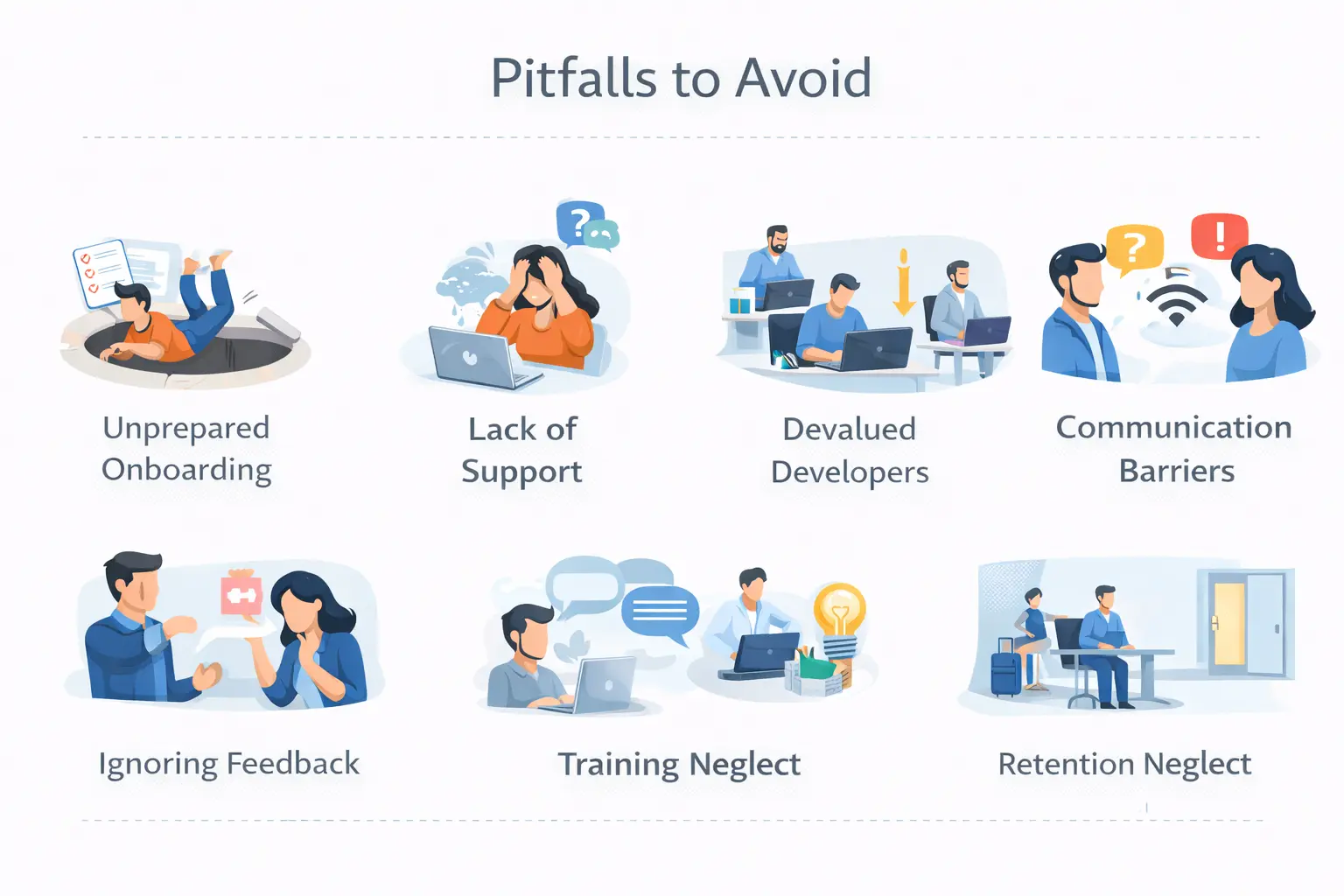
Common Nearshore Onboarding Pitfalls (And How to Avoid Them)
After 15 years and thousands of nearshore placements, we've seen the same mistakes repeatedly. Here's what goes wrong—and how to avoid it.
Pitfall #1: "Set It and Forget It" Mentality
What happens: Hire a developer, assign them tickets, assume they'll figure it out. Check in a month later and discover they're lost, unproductive, and frustrated.
Why it fails: Nearshore developers, especially in the first 30 days, need active management. Without regular touchpoints, small problems compound into major issues.
How to avoid:
- Schedule daily 15-minute check-ins for the first two weeks
- Weekly 1-on-1s for the first 90 days (minimum)
- Use async updates (daily Slack standup bot, weekly written summaries)
- Explicitly assign responsibility: "Who is managing this developer's onboarding?"
Pitfall #2: No Clear First Task
What happens: Developer starts on Monday. By Tuesday afternoon, they're still "reading documentation" and "getting familiar with the codebase" with no concrete deliverable.
Why it fails: Momentum matters. Developers want to contribute quickly and prove their value. Ambiguity early on erodes confidence.
How to avoid:
- Identify a specific, scoped first task before their start date
- Ideal first task: 1-3 days, clearly defined, low-risk, requires touching real code
- Have the onboarding buddy walk through it on day one
- Celebrate when they complete it (even if it's small)
Pitfall #3: Assuming They'll Ask Questions
What happens: Developer struggles with unclear requirements, broken development environment, or confusing architecture. They don't ask for help. Weeks pass. Productivity stalls.
Why it fails: Cultural norms vary. In many Latin American work cultures, asking too many questions is seen as bothering busy people or admitting incompetence.
How to avoid:
- Create explicit "question time" where asking is expected, not tolerated
- Model question-asking: "I don't know either—let's find out together"
- Use your 1-on-1s to explicitly dig: "What's been confusing this week?"
- Celebrate questions publicly: "Great question—others probably wondered the same thing"
Pitfall #4: Over-Reliance on Async Without Relationship Building
What happens: All interaction is transactional: tickets assigned, PRs reviewed, Slack messages exchanged. No personal connection. Developer feels like a code-writing service, not a team member.
Why it fails: Retention and engagement require relationship. People stay on teams they care about, not just jobs that pay.
How to avoid:
- Schedule regular video calls (cameras on)
- Host informal virtual coffee chats with no agenda
- Participate in non-work conversations (hobbies, sports, life updates)
- Acknowledge birthdays, work anniversaries, personal milestones
- Invite them to team events (even if virtual)
Pitfall #5: Ignoring Time Zone Realities
What happens: Schedule all team meetings at 10 AM your time (6 AM theirs). Expect immediate Slack responses during their evening. Treat async work as an afterthought.
Why it fails: Disrespecting time zones signals "you're not really part of the team." It also burns people out.
How to avoid:
- Rotate meeting times so time zone burden is shared
- Establish "core hours" where overlap is guaranteed (e.g., 2-5 PM your time)
- Use async tools (Loom, recorded meetings, detailed written updates) proactively
- Document everything so people can catch up without live attendance
- Respect their offline time (don't expect responses after 6 PM their time)
Pitfall #6: No Performance Feedback Until It's Too Late
What happens: Developer underperforms or misunderstands expectations for weeks. No feedback is given. Manager finally addresses it at month three when frustration boils over.
Why it fails: Lack of feedback prevents course correction. Small issues become major problems. Trust erodes.
How to avoid:
- Provide feedback weekly in the first month
- Be specific: "I noticed X. Here's why that matters. Here's what I'd like to see instead."
- Balance positive and constructive: "You did Y really well. Let's improve Z."
- Create psychological safety: "Feedback is how we grow. I'll give you feedback, and I expect you to give me feedback too."
Pitfall #7: Treating Nearshore as "Cheaper Labor" Rather Than Team Members
What happens: Nearshore developers get grunt work, unclear requirements, and lower priority. They're excluded from strategic discussions, social events, and growth opportunities.
Why it fails: Nobody wants to be treated as a second-class team member. Top talent leaves for companies that value them.
How to avoid:
- Give nearshore developers the same quality of work as local team members
- Include them in technical strategy, architecture decisions, and product discussions
- Invest in their career development (courses, conferences, certifications)
- Promote from within your nearshore team when appropriate
- Publicly recognize their contributions in team meetings and channels
Success Metrics: How to Measure Nearshore Developer Onboarding Effectiveness
Great onboarding isn't subjective—it's measurable. Track these metrics to assess whether your process is working.
FAQs: Nearshore Developer Onboarding
1. How long does nearshore developer onboarding typically take?
Functional productivity (60-70%): 3-4 weeks with structured onboardingFull productivity (90%+): 6-8 weeks for mid-level, 8-10 weeks for senior developersFull integration (culturally and technically): 3-6 months
These timelines assume you follow a structured process. Without clear onboarding, timelines double.
2. What's the biggest difference between onboarding nearshore vs. local developers?
Time zone management: You can't rely on hallway conversations or impromptu desk visits. Everything requires intentional structure.
Cultural integration: Building trust and rapport remotely takes longer. Relationship-building must be proactive, not organic.
Communication style: Async communication becomes primary. You need excellent documentation, Loom videos, and written context.
3. Should I assign an onboarding buddy or have the manager handle it?
Both. The manager owns overall responsibility (goal setting, performance, career growth). The onboarding buddy owns day-to-day support (answering questions, pairing, code review guidance).
Best practice: Manager does 1-on-1s, big-picture conversations, and performance feedback. Buddy handles tactical "how do I do X?" questions.
4. What if my nearshore developer isn't asking questions when they're stuck?
This is common due to cultural norms around not wanting to bother busy people. Solutions:
- Schedule explicit "question office hours" where asking is expected
- Proactively check in: "What's unclear? Where are you stuck?"
- Model question-asking: "I don't know either—let's figure it out together"
- Create a "no dumb questions" Slack channel
- Normalize questions publicly: "Great question—I bet others wondered too"
5. How much time should I expect to invest in onboarding?
Week 1: 5-7 hours (intro meetings, tool setup support, first task walkthrough)Week 2-4: 3-5 hours/week (1-on-1s, code reviews, pair programming)Week 5-8: 2-3 hours/week (ongoing 1-on-1s, feedback, check-ins)
Total: 25-35 hours over 8 weeks. This is frontloaded investment that pays off with years of productivity.
6. What tools are essential for nearshore developer onboarding?
Must-have:
- Version control (GitHub, GitLab)
- Communication (Slack, Teams)
- Project management (Jira, Linear)
- Video conferencing (Zoom, Google Meet)
- Screen recording (Loom) for async explanations
- Documentation (Confluence, Notion, or internal wiki)
Nice-to-have:
- Code pairing tools (Tuple, VS Code Live Share)
- Developer environment automation (Docker, devcontainers)
- Onboarding task tracker (Notion templates, custom checklists)
7. How do I balance async vs. sync communication with nearshore developers?
Use synchronous time (2-4 hour overlap) for:
- High-bandwidth discussions (brainstorming, architectural debates)
- Relationship building (1-on-1s, team bonding)
- Pair programming on complex problems
- Clarifying ambiguity in real-time
Use asynchronous communication for:
- Status updates (daily standups via Slack bot)
- Code reviews (GitHub PR comments)
- Sharing context (Loom screen recordings)
- Documentation and announcements
Rule of thumb: Use your overlap time wisely. Don't waste it on things that could be async.
8. What if I notice performance issues in the first month?
Address them immediately. Waiting compounds problems. Use this approach:
- Diagnose: Is it skills, clarity, tools, or motivation?
- Provide specific feedback: "I noticed X. Here's why it matters. Here's what I'd like to see."
- Create a plan: "Let's pair on this together next week so I can show you our approach."
- Follow up: Check progress in 1-2 weeks. Has the issue improved?
- Escalate if needed: If no improvement after intervention, involve your staffing partner.
9. How do I know if the onboarding is going well?
Positive signals:
- Developer completes first meaningful task within 2 weeks
- They proactively ask clarifying questions when stuck
- Code review feedback is being incorporated quickly
- They participate actively in team discussions
- Relationship with onboarding buddy is strong
- They express excitement about the work and team
Warning signals:
- Silence for days (no questions, no updates)
- Repeated misunderstandings of requirements
- Low engagement in team meetings
- Code quality concerns after week 3-4
- Consistently working late nights or weekends (burnout risk)
10. What happens after the first 90 days?
Onboarding transitions to ongoing management:
- Shift from weekly 1-on-1s to bi-weekly (or keep weekly if they prefer)
- Move from explicit supervision to autonomous ownership
- Begin career development conversations (growth goals, skill building)
- Involve them in mentoring future new hires
- Focus on retention: Are they engaged, growing, and happy?
Conclusion: Invest in Onboarding, Reap Long-Term Success
Nearshore developer onboarding isn't a two-day orientation. It's an 8-week process that determines whether your hire becomes a high-performing, long-term team member or a frustrating, short-lived experiment.
The companies that succeed with nearshore teams share one thing in common: they take onboarding seriously.
They don't treat nearshore developers as "cheaper code writers." They invest time, provide clarity, build relationships, and create environments where developers thrive.
The return on that investment is extraordinary:
- 60% faster time-to-productivity
- 40% higher first-year retention
- Stronger team cohesion and collaboration
- Better code quality and fewer post-hire regrets
- Developers who become long-term assets, not temporary contractors
This playbook gives you the framework. Now it's your turn to execute.
Download Your Onboarding Checklists
We've created two versions of our Nearshore Developer Onboarding Checklist to support your process:
Download Checklist with Timeline Tracker
Download Printable PDF Checklist
Ready to Hire Nearshore Developers Who Actually Succeed?
At BetterWay Devs, we don't just connect you with talented developers from Latin America, we ensure they succeed long-term.
Here's how we help:
- We handle all administrative complexity (contracts, benefits, compliance) so you focus on management
- We provide comprehensive candidate profiles so you understand who you're working with from day one
- We offer ongoing support throughout the relationship, not just the hiring process
We believe in radical transparency: We won't tell you onboarding is easy. We'll tell you it requires investment, and then we'll show you exactly how to do it right.
If you're ready to build a high-performing nearshore development team, talk to our team or explore our developer network.
About BetterWay Devs For 15 years, Atlanticsoft Inc dba BetterWay Devs, has connected US companies with exceptional software developers from Colombia and Latin America. We specialize in Colombia-based talent and take a transparent, relationship-focused approach to nearshore staffing. Unlike staffing agencies that disappear after the hire, we partner with you to ensure long-term success. Learn more about our approach.


.png)
